
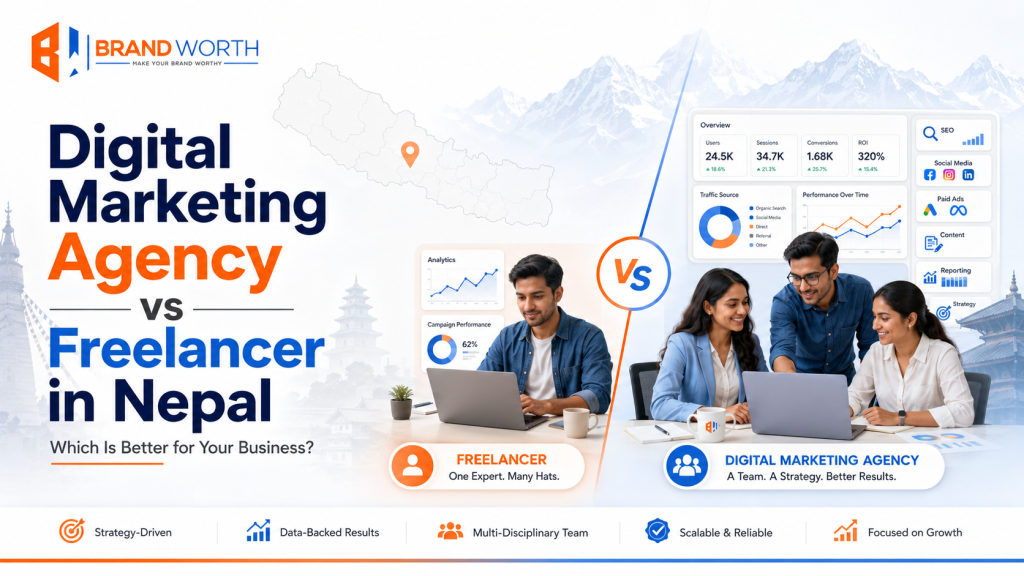
A freelancer may be the better option for a clearly defined task such as designing social media posts, editing videos, writing articles or managing one advertising platform. A digital marketing agency may be more suitable when a business needs coordinated strategy, multiple specialists, campaign continuity, structured reporting and execution across several channels.
Neither option is automatically better. A highly experienced freelancer can outperform a poorly managed agency, while a capable agency can deliver expertise and continuity that one individual may be unable to provide. The decision should be based on capabilities, accountability and business fit rather than job title alone.
This guide compares a digital marketing agency vs freelancer in Nepal across strategy, expertise, reliability, communication, account ownership, quality control, scalability and suitable use cases. It also provides a practical decision framework for startups, small businesses, corporate organisations and institutions.
Should You Hire a Digital Marketing Agency or a Freelancer?
Hire a freelancer when the assignment is specialised, limited in scope and manageable by one person. Hire an agency when the work requires several disciplines, continuous execution, strategic coordination, backup resources and formal reporting. A hybrid model is often effective when an internal marketing manager directs the strategy while freelancers or an agency provide specialised execution.
Key Takeaways
- A freelancer is generally suitable for a focused task, short project or single specialist requirement.
- An agency is generally suitable for ongoing, multi-channel campaigns requiring several skills and coordinated management.
- The term “agency” does not guarantee quality, and the term “freelancer” does not imply limited expertise.
- Businesses should evaluate the actual people, processes, experience and accountability behind each option.
- Account ownership, data access, documentation and handover procedures should be agreed before work begins.
- A hybrid model can combine internal business knowledge with external specialist capabilities.
- The right decision depends on the business objective, not simply on which option appears cheaper.
What Is a Freelance Digital Marketer?
A freelance digital marketer is an independent professional who provides marketing services directly to businesses, agencies or other clients. Freelancers may work alone, collaborate with other specialists or operate as a small informal team.
Some freelancers provide several services, while others specialise in one area such as:
- Search engine optimisation
- Google Ads management
- Facebook and Instagram advertising
- Social media management
- Graphic design
- Copywriting and blog content
- Website development
- Video editing
- Photography
- Email marketing
- Analytics and reporting
A freelancer can be an efficient choice when the assignment can be completed by one specialist and the client already knows what needs to be done.
However, the quality and working style of freelancers vary considerably. Some have deep expertise, strong systems and years of experience. Others may be early in their careers, managing too many clients or offering services outside their core capabilities.
What Is a Digital Marketing Agency?
A digital marketing agency is an organisation that uses a team of strategists, account managers, designers, writers, advertisers, SEO specialists, developers, analysts and content producers to plan and execute marketing activities.
Depending on its structure, an agency may provide:
- Market and audience research
- Digital marketing strategy
- Brand and campaign planning
- SEO and local search optimisation
- Google Ads and performance marketing
- Social media management
- Content writing and graphic design
- Photography and video production
- Influencer marketing
- Website and landing-page development
- Conversion tracking and reporting
- Traditional and digital media coordination
An agency is generally most valuable when a campaign requires several skills to work together. For example, a lead-generation campaign may need customer research, advertising strategy, copywriting, graphic design, landing-page development, conversion tracking and sales-quality reporting.
Businesses considering an agency can also read BrandWorth’s complete guide to choosing a digital marketing agency in Nepal.
Digital Marketing Agency vs Freelancer in Nepal: Quick Comparison
| Decision Factor | Freelancer | Digital Marketing Agency |
|---|---|---|
| Best suited for | Focused tasks and specialised assignments | Ongoing and multi-channel campaigns |
| Skills available | Usually one or a limited number of specialties | Multiple specialists within one team |
| Communication | Direct communication with the person completing the work | Communication may be managed through an account lead |
| Capacity | Limited by one person’s workload and availability | Work can be distributed across several team members |
| Continuity | Greater dependency on one individual | Backup resources may be available |
| Strategy | Depends on the freelancer’s experience and scope | May combine research, planning, execution and analysis |
| Speed | Can be fast for a clearly defined task | Can coordinate larger amounts of work simultaneously |
| Quality control | Usually handled by the freelancer and client | May include internal reviews and specialist supervision |
| Tools and systems | Depends on the individual | May include shared tools, workflows and reporting systems |
| Scalability | May require hiring additional freelancers | Scope can often expand across the agency team |
| Accountability | Direct personal responsibility | Formal responsibility through a company and contract |
| Ideal client | A business that can manage and direct the assignment | A business needing coordinated strategic and execution support |
These are common differences rather than universal rules. A specialised freelancer may have more expertise than a general agency, and a small agency may have less capacity than a well-organised freelance team.
When Is a Freelancer the Better Choice?
A freelancer is often the better choice when the requirement is specific, the project has a clear beginning and end, and one person can reasonably deliver the expected result.
1. You Need One Specialised Skill
A freelancer may be ideal when your internal team already has a strategy but needs a specialist to complete a particular task.
Examples include:
- Writing four SEO articles
- Editing a series of short videos
- Designing a landing page
- Setting up a Google Analytics dashboard
- Conducting a technical SEO audit
- Creating a logo or campaign key visual
- Managing one Google Ads campaign
2. The Work Has a Limited Scope
A well-defined project is easier to assign to an individual. The expected output, deadline, revision process and completion criteria can be agreed before work starts.
3. Your Internal Team Can Provide Direction
Freelancers work best when the client can provide a clear brief, timely feedback, brand assets, access and approvals. The business should also have someone capable of evaluating the quality of the work.
4. You Want Direct Access to the Specialist
Working with a freelancer often means communicating directly with the person designing, writing, editing or managing the campaign. This can reduce layers of communication for a focused assignment.
5. You Are Testing a New Channel
A business may hire a specialist freelancer to test whether a specific channel deserves further investment. For example, it may test search advertising, email automation or short-form video before building a larger programme.
6. You Need Temporary Support
Freelancers can help during a busy campaign period, employee absence, product launch or temporary increase in content requirements.
When Is a Digital Marketing Agency the Better Choice?
An agency is generally the better choice when marketing requires several skills, continuous management, coordinated execution and accountability across a wider scope.
1. You Need Several Specialists
A campaign involving SEO, paid advertising, design, content, video, website optimisation and analytics may be difficult for one person to execute at a consistently high standard.
An agency can assign different responsibilities to people with relevant expertise while maintaining one central campaign direction.
2. You Need Strategy and Execution
Some businesses know they need growth but do not know which channels, audiences, messages or offers should be prioritised. An agency may provide research, planning and execution rather than waiting for the client to provide detailed instructions.
3. The Campaign Is Ongoing
Continuous marketing requires content calendars, advertisements, optimisation, community management, reports, meetings and revisions. An agency structure may provide more continuity for long-term work.
4. The Business Has a High Volume of Work
A product launch, admission campaign, national awareness programme or multi-location business may require several assets and activities to be delivered at the same time.
5. The Campaign Uses Multiple Channels
A campaign may need to coordinate Google Search, Meta advertising, social content, video, influencers, public relations, outdoor media and events. An agency can help maintain one message across those channels.
6. You Need Formal Reporting and Governance
Corporate organisations, NGOs, healthcare institutions, educational organisations and international companies may need documented strategies, approval procedures, reports, contracts, invoices, confidentiality and defined responsibilities.
7. Business Continuity Is Important
When one team member is unavailable, an agency may be able to reassign work. This reduces dependence on one person, although clients should still ask how backup and handover are managed.
8. You Plan to Scale
A business may begin with social media and advertising but later require SEO, video, website improvement, research or broader media support. An agency with relevant capabilities can expand the programme without replacing the entire delivery structure.
When Does a Hybrid Marketing Model Work Best?
A hybrid model combines an internal employee or marketing manager with external specialists. This can provide the business knowledge and control of an in-house team while adding the specialist capabilities of freelancers or an agency.
Common Hybrid Models
- An internal marketing manager working with a full-service agency
- An internal content team supported by an SEO specialist
- An agency managing strategy while freelancers provide specialist production
- An internal sales team working with an external lead-generation agency
- An internal designer supported by an advertising and media agency
- An agency managing campaigns while an internal spokesperson creates expert content
Advantages of a Hybrid Model
- Strong internal knowledge of products and customers
- Direct organisational ownership
- Access to external specialists
- Greater capacity during major campaigns
- Better continuity when responsibilities are clearly divided
Potential Hybrid-Model Problems
- Duplicated responsibilities
- Conflicting instructions
- Slow approvals
- Unclear ownership of results
- Different teams using inconsistent information
A written responsibility matrix should identify who develops strategy, approves content, owns accounts, supplies information, handles customers and reports results.
Agency or Freelancer: Choosing by Business Size and Stage
New Startup
A new startup may not need a large multi-channel campaign immediately. It may benefit from a specialised freelancer for branding, website development or initial content while the founders validate the product and customer demand.
An agency becomes more valuable when the startup needs coordinated customer acquisition, campaign testing, analytics and continuous production.
Small Local Business
A small restaurant, shop, clinic or professional service provider may begin with a freelancer who can improve local visibility, social content or basic advertising.
An agency may be appropriate when the business operates several locations, requires regular lead generation or cannot manage multiple suppliers internally.
Growing Small or Medium-Sized Business
A growing business usually needs more coordination. Its marketing may include SEO, advertisements, content, website updates, customer retention and regional expansion. A hybrid model or agency relationship may provide stronger continuity than hiring separate individuals for every channel.
Corporate Organisation
A corporate organisation often requires multiple approval levels, consistent brand standards, professional production, detailed reporting and coordination across departments. An established agency may be better equipped for this environment.
NGO or Development Organisation
An NGO may require research, public-awareness content, field documentation, multilingual communication, events, media relations and donor reporting. The best choice depends on the project scope, but complex campaigns commonly require a coordinated team.
International Company Entering Nepal
An international organisation may need local market insight, cultural interpretation, Nepali-language content, media understanding and campaign execution. A local agency with research and production capabilities can reduce the difficulty of coordinating multiple independent suppliers.
Freelancer vs Agency by Digital Marketing Service
SEO
An experienced freelance SEO specialist may be highly effective for a website audit, keyword strategy, technical consultation or content plan.
An agency may be more suitable when SEO requires developers, writers, designers, local optimisation, digital PR, analytics and continuous implementation. Businesses can learn more from BrandWorth’s guide to SEO in Nepal, Google Maps and AI search.
Google Ads
A specialist freelancer can manage focused search or display campaigns, particularly when the business already has suitable landing pages and accurate tracking.
An agency may provide additional support through market research, copywriting, creative development, landing pages, conversion tracking and coordination with the sales team.
Social Media Marketing
A freelancer may handle content calendars, captions, graphics or community management for a limited number of platforms.
An agency may be better when social media requires strategy, photography, video, influencer coordination, advertising, campaign concepts and rapid production across several accounts.
Content Marketing
A specialist writer or editor may be the best choice for high-quality articles, scripts, newsletters or case studies.
An agency may add value when content must connect with SEO, social media, advertising, video, lead generation and brand strategy.
Graphic Design
A freelance designer can be efficient for a defined design requirement and may develop a strong understanding of the brand over time.
An agency may provide broader creative direction, copywriting, art direction, quality review and adaptation across different campaign formats.
Photography and Video Production
A freelancer may be appropriate for interviews, event highlights, product photography or video editing when the production requirement is straightforward.
A production-intensive campaign may require directors, cinematographers, lighting, sound, scriptwriting, presenters, equipment, animation and post-production. In that situation, a coordinated production-house team may be more practical.
Website Development
A freelance developer may be suitable for a small website, landing page, maintenance task or technical improvement.
An agency may be better when the website requires research, information architecture, copywriting, search optimisation, design, development, analytics and campaign integration.
Integrated Campaigns
A campaign involving digital advertising, television, radio, print, outdoor media, public relations, influencers and events generally requires central coordination. An integrated media and campaign team can help maintain one message and measurement framework across channels.
Nepal-Specific Factors to Consider
Nepali and English Communication
Some audiences respond best to Nepali content, others prefer English, and many campaigns require both. The person or team you hire should understand how language affects tone, trust and clarity rather than translating content word for word.
Local Market Knowledge
Campaigns should reflect local buying behaviour, geographical differences, seasonal demand, festivals, media habits, distribution capacity and customer expectations.
Execution Outside Kathmandu
A campaign may need content production, influencers, events or local coordination in several cities. Ask whether the freelancer or agency has the capacity and network to manage regional execution.
Traditional and Digital Media
Many Nepali campaigns use digital channels alongside television, radio, print, outdoor advertising, events and public relations. A business using several channels should decide who will maintain the central strategy and message.
Advertising Payments and Administration
Discuss who will fund platform spending, manage invoices, handle billing access and document advertising expenses. Media spending should remain clearly separated from professional service fees.
Local Content Production
Producing locally relevant photography and video may require location access, presenters, scripts, permissions, travel and coordination. Confirm whether these responsibilities are included or handled by separate suppliers.
Sales Follow-Up
A marketing partner may generate enquiries, but the business still needs a process to contact, qualify and convert them. The agency or freelancer should understand how lead quality will be communicated back to the campaign team.
Account Ownership and Data Access
The business should retain appropriate ownership and administrative control of its core digital assets, regardless of whether it hires a freelancer or an agency.
Accounts the Business Should Control
- Domain registration
- Website hosting
- Content management system
- Google Business Profile
- Google Analytics
- Google Search Console
- Google Tag Manager
- Google Ads
- Meta Business Portfolio
- Facebook Page
- Instagram business account
- YouTube channel
- TikTok business account
- Email marketing platform
- Customer relationship management system
- Design and production assets
Google Ads allows businesses to grant, change and remove access to users while continuing to work within the same client account. Review Google’s official guide to managing Google Ads account access.
Google Search Console also provides owner and user permission levels. The business should maintain at least one appropriate verified owner and understand who can manage users. Review Google’s documentation on Search Console owners and permissions.
Questions to Settle Before Work Begins
- Who creates each account?
- Which email address is used as the primary owner?
- What access level will the service provider receive?
- Who controls billing?
- Who can add or remove users?
- Who receives source files and raw footage?
- What happens to access when the contract ends?
- How will passwords and sensitive data be protected?
Reliability, Continuity and Risk
Freelancer Continuity Risk
A freelancer may become unavailable because of illness, workload, travel, employment changes or personal circumstances. This does not make freelancers unreliable, but the business should understand how urgent work and handover will be managed.
Agency Continuity Risk
An agency may have backup resources, but clients can still face account-manager changes, staff turnover, delayed approvals or inconsistent quality. Ask how knowledge is documented and transferred between team members.
Reducing Dependency
- Use business-owned accounts.
- Maintain shared folders and documentation.
- Record campaign settings and decisions.
- Store approved creative assets centrally.
- Agree on notice and handover procedures.
- Ensure more than one authorised business representative has access.
- Review access permissions regularly.
How to Choose Between an Agency and a Freelancer
Step 1: Define the Outcome
State the business result you need. Examples include increasing qualified enquiries, improving Google visibility, launching a product, building a website or producing a campaign video.
Step 2: List the Skills Required
Identify whether the objective requires one specialist or several connected skills. A campaign requiring research, strategy, design, advertising, landing pages and analytics is different from a task requiring one video editor.
Step 3: Define the Workload
Estimate the number of campaigns, platforms, assets, meetings, reports and revisions required. Determine whether one person can reasonably complete the work.
Step 4: Assess Internal Management Capacity
Decide who will create briefs, provide information, approve work, review quality and coordinate suppliers. Separate freelancers may require more internal management than one agency relationship.
Step 5: Identify the Risks
Consider deadlines, confidentiality, account access, business continuity, campaign complexity and the impact of delayed delivery.
Step 6: Compare Actual People and Processes
Do not compare an imagined ideal freelancer with an actual agency, or an ideal agency with an actual freelancer. Compare the specific candidates based on relevant work, communication, process and accountability.
Step 7: Review the Proposed Approach
Ask each candidate to explain what should be prioritised, which channels should be avoided and how results will be measured.
Step 8: Start With a Defined Engagement
When uncertainty is high, begin with an audit, strategy project, campaign test or limited initial phase. Use the results and working relationship to decide whether the engagement should expand.
Digital Marketing Agency vs Freelancer Decision Scorecard
Score each shortlisted option from one to five in every category. Multiply the score by the weighting and compare the final totals.
| Evaluation Area | Weight | What to Evaluate |
|---|---|---|
| Understanding of your business | 15% | Quality of questions, research and understanding of the objective |
| Relevant expertise | 15% | Experience with the required channels and type of work |
| Strategic ability | 15% | Ability to prioritise, plan and connect activity with business outcomes |
| Execution capacity | 15% | Ability to complete the required volume and complexity of work |
| Measurement and reporting | 10% | Tracking, reporting, analysis and optimisation process |
| Reliability and continuity | 10% | Availability, backup, documentation and handover planning |
| Communication | 10% | Clarity, response process, meeting structure and feedback management |
| Ownership and transparency | 5% | Account control, data access, subcontracting and expense clarity |
| Commercial value | 5% | Quality and suitability of the proposed solution relative to total investment |
The highest score should not automatically determine the decision. Use the scorecard to identify strengths, weaknesses and questions requiring clarification.
Questions to Ask a Freelancer
- Which digital marketing services do you specialise in?
- Which services do you not provide?
- Can you show work involving similar objectives?
- How many active clients are you currently managing?
- Who completes the work?
- Do you subcontract any part of the assignment?
- What information and access do you need from us?
- How will progress and results be reported?
- What is your usual response time?
- What happens if you become unavailable?
- Who owns the accounts and source files?
- How are revisions and additional work handled?
- What is the notice and handover process?
Questions to Ask a Digital Marketing Agency
- Who will lead our strategy and account?
- Who will perform each part of the work?
- Which services are managed internally?
- Will any work be outsourced?
- How will your specialists coordinate with one another?
- What research will be completed before execution?
- Which channels do you recommend, and why?
- Which channels should we avoid initially?
- How will conversions and qualified leads be measured?
- How frequently will we receive reports and meetings?
- How will account ownership and access be managed?
- What happens when an assigned team member leaves?
- What are the contract, notice and handover terms?
Freelancer and Agency Red Flags
Red Flags That Apply to Both
- Guaranteeing immediate rankings, leads or sales without research
- Recommending the same strategy to every business
- Refusing to provide appropriate account access
- Using only followers, reach and impressions as proof of success
- Being unable to explain how conversions will be tracked
- Showing work without clearly explaining their contribution
- Avoiding written deliverables and responsibilities
- Using artificial followers, engagement or misleading reports
- Failing to separate professional fees from advertising spending
- Having no clear exit or handover procedure
Freelancer-Specific Warning Signs
- Claiming expert-level capability across every marketing discipline
- Managing more work than one person can reasonably deliver
- Having no process for backup or emergency availability
- Using personal accounts as the permanent owner of client assets
- Providing no documentation of campaign settings or completed work
Agency-Specific Warning Signs
- The sales team cannot identify who will work on the account.
- Senior experts appear only during the sales presentation.
- The proposal contains high volumes of deliverables but no strategic reasoning.
- The agency cannot explain internal review and quality-control procedures.
- Important work is outsourced without transparency.
How to Manage the Relationship Successfully
The success of a freelancer or agency relationship also depends on the client. A strong service provider may still struggle when information is incomplete, approvals are delayed or business goals continually change.
Client Responsibilities
- Provide accurate business and product information.
- Assign a responsible contact person.
- Give timely access and approvals.
- Share brand guidelines and existing assets.
- Explain legal, operational or compliance restrictions.
- Report lead and sales quality.
- Communicate changes in stock, pricing, locations and offers.
- Review reports and participate in strategic decisions.
Service-Provider Responsibilities
- Clarify the scope and expected outcomes.
- Communicate progress and problems honestly.
- Protect accounts and confidential information.
- Document important decisions.
- Report meaningful performance information.
- Recommend changes based on evidence.
- Complete handover responsibilities when the engagement ends.
When an Integrated Agency Model Makes Sense
A business may initially compare a freelancer with a digital agency but later discover that its campaign also requires market research, professional production, advertising, media placement, public relations or events.
An integrated agency model can be valuable when these activities need to share one campaign idea, audience strategy and measurement framework.
BrandWorth brings together market research, advertising, production, digital marketing services, media campaigns and events through one coordinated approach.
This model may suit organisations that need:
- Audience research before campaign development
- One message across several channels
- Digital and traditional media integration
- Professional photography and video
- National or regional campaign execution
- Influencers, media and events working together
- Centralised reporting and accountability
A business needing only one clearly defined service may still be better served by an experienced freelancer or specialist provider. The objective should always determine the delivery model.
Learn more about BrandWorth’s research, campaign and measurement approach or review the broader digital marketing guide for businesses in Nepal.
Final Decision Checklist
- We have defined the business outcome.
- We know which skills are required.
- We understand the expected workload.
- We have identified who will manage the relationship internally.
- We have reviewed relevant work and references.
- We have met the person or team completing the work.
- We understand which activities will be outsourced.
- We know how results will be measured.
- We will retain appropriate ownership of our accounts and data.
- The scope, revisions and exclusions are documented.
- There is a plan for unavailability, transition and handover.
- The recommended solution fits our objective rather than following a generic package.
Choose the Delivery Model That Fits the Work
The choice between a digital marketing agency and a freelancer should not be treated as a competition between two job titles. It is a decision about the expertise, capacity, coordination and accountability your business needs.
Choose a freelancer when the assignment is specific, the required expertise is concentrated in one area and your internal team can direct the work. Choose an agency when the campaign requires several specialists, ongoing execution, strategic integration and reliable continuity.
Choose a hybrid model when your internal team should retain daily ownership while external specialists provide additional capability.
Businesses that need coordinated research, digital strategy, advertising, content production, media and campaign execution can contact BrandWorth for a strategic consultation.
Frequently Asked Questions
Is a digital marketing agency better than a freelancer?
An agency is not automatically better than a freelancer. An agency is usually more suitable for multi-channel campaigns requiring several specialists, while a freelancer may be better for a focused task that can be completed by one experienced professional.
Should a small business in Nepal hire an agency or a freelancer?
A small business with a limited and clearly defined requirement may begin with a freelancer. An agency may be more appropriate when the business needs continuous lead generation, several marketing channels or coordinated content, advertising and reporting.
When should a startup hire a digital marketing agency?
A startup should consider an agency when it has validated its offer and needs coordinated customer acquisition, campaign testing, analytics, content and specialist support. During an early validation stage, one or two experienced freelancers may be sufficient.
Can one freelancer manage complete digital marketing?
Some experienced freelancers can manage several channels, but complete digital marketing may require strategy, SEO, advertising, design, writing, video, development and analytics. Businesses should confirm whether one person can realistically provide every required capability.
What are the main risks of hiring a freelancer?
The main risks include dependency on one person, limited capacity, availability issues and gaps outside the freelancer’s primary expertise. Clear documentation, business-owned accounts and a handover plan can reduce these risks.
What are the main risks of hiring an agency?
Agency risks can include unclear team assignments, communication layers, staff changes, inconsistent quality and paying for services that are not necessary. Businesses should review the actual delivery team, process, scope and reporting system.
Can a business hire both an agency and freelancers?
Yes. A hybrid model can work effectively when responsibilities are clearly divided. An agency may manage strategy and campaigns while specialist freelancers support photography, writing, development or other defined assignments.
Who should own the advertising and analytics accounts?
The business should generally retain ownership or primary administrative control of its advertising, analytics, website and social media accounts. Freelancers and agencies should receive the access required to perform their work.
How should I compare a freelancer and an agency?
Compare their understanding of your business, relevant expertise, strategy, execution capacity, reliability, communication, reporting, account-ownership policy and commercial value. Evaluate the actual candidates instead of relying on assumptions about freelancers or agencies.
How do I choose a digital marketing agency in Nepal?
Define your business objective, identify the capabilities required, review the proposed team and process, verify account ownership, examine relevant work and ask how results will be measured. Read BrandWorth’s complete agency-selection guide for a detailed evaluation framework.
Turn the insight into action.
Tell us what you are trying to grow, launch or improve. We will connect you with the right specialist team.
Discuss your project →