
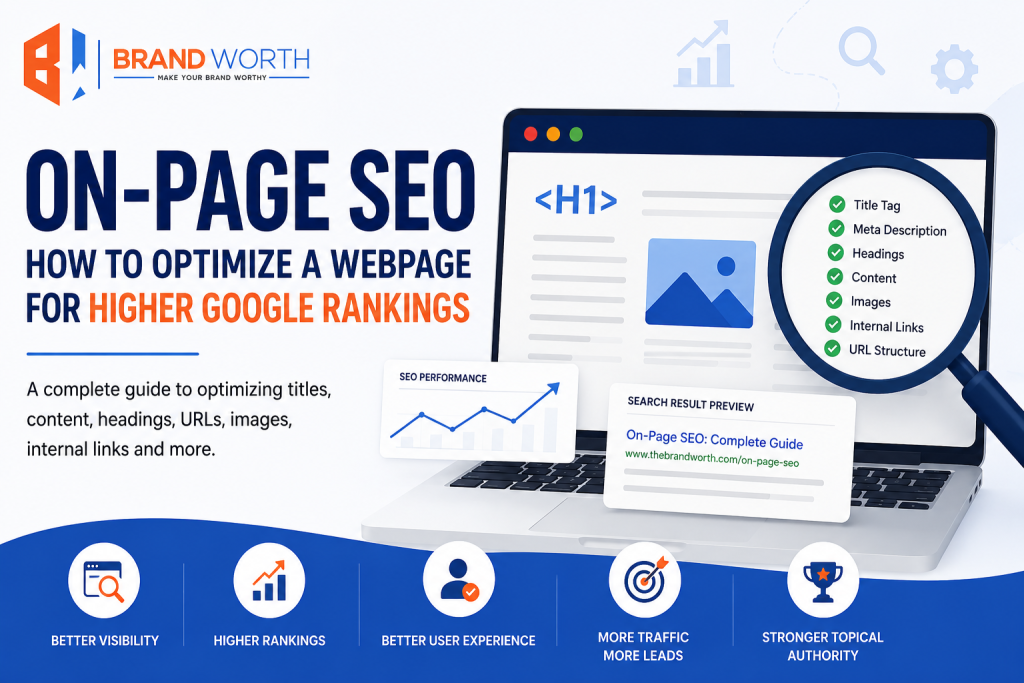
On-page SEO is the process of improving an individual webpage so that search engines can understand its purpose and users can quickly find the information they need. It includes search-intent alignment, content quality, page structure, title elements, headings, URLs, images, internal links, entities, supporting evidence and conversion paths.
The biggest mistake is reducing on-page SEO to a checklist such as “put the keyword in the title, H1 and first paragraph.”
That approach misses the real objective.
A well-optimized page should make three things exceptionally clear:
What is this page about? Who is it for? Why is it a better result for that search than the alternatives?
Google’s Search Essentials recommends creating helpful, reliable, people-first content and using the words people search for in prominent places such as the page title, main heading, alt text and link text. (Google for Developers)
But keywords are only part of the job.
Modern on-page SEO requires aligning search intent, information architecture, topical depth, entities, internal relationships and user experience around one clearly defined purpose.
For businesses building a broader organic-search strategy, this guide fits into the process after keyword research, search intent analysis and keyword mapping. Once you know what people search for, what they want and which URL should target the opportunity, on-page SEO determines how well that page actually satisfies the search.
What Is On-Page SEO?
On-page SEO means optimizing the content and page-level elements of a webpage to make its topic, purpose and value easier for users and search engines to understand.
It typically includes the page’s title, main heading, supporting headings, written content, media, links, URL, metadata and structured information.
Brand Worth’s broader SEO in Nepal guide treats on-page SEO as one component of a larger SEO system alongside keyword research, technical SEO, local SEO, content, authority and measurement. (Brand Worth)
This distinction matters because a perfectly written page can still struggle if the website has crawling, indexing, canonicalization or performance problems. Likewise, a technically perfect website will not necessarily rank if individual pages fail to answer what users are searching for.
On-page SEO connects the query to the page.
On-Page SEO vs Technical SEO vs Off-Page SEO
On-page SEO optimizes individual pages, technical SEO improves the infrastructure that allows those pages to be crawled and understood, and off-page SEO builds authority and reputation outside the page itself.
| SEO Area | Primary Focus | Typical Work |
|---|---|---|
| On-page SEO | Individual webpage relevance and usefulness | Content, titles, headings, entities, images, internal links |
| Technical SEO | Crawling, rendering, indexing and site infrastructure | Canonicals, redirects, XML sitemaps, robots.txt, performance |
| Off-page SEO | External authority and reputation | Digital PR, relevant mentions, earned links, citations |
| Local SEO | Geographic relevance | Local pages, Google Business Profile, local signals |
Brand Worth’s Technical SEO in Nepal guide makes the same architectural distinction: on-page SEO concentrates primarily on content and visible page-level elements, while technical SEO deals more closely with structure, code, servers and the CMS. (Brand Worth)
The disciplines overlap, but they should not be confused.
Changing a title tag will not repair an indexing problem. Improving Core Web Vitals will not make thin content suddenly satisfy search intent.
Strong SEO requires both.
Why Is On-Page SEO Important?
On-page SEO helps a webpage communicate its relevance, satisfy search intent and give visitors enough value to continue their journey rather than returning to search for a better answer.
Google says its ranking systems assess many factors and signals to surface relevant and useful results. (Google for Developers) It also advises publishers to focus on content created primarily for people and asks whether readers will leave feeling they learned enough to achieve their goal. (Google for Developers)
That gives marketers a better way to think about optimization.
Do not ask only:
“Did we include the keyword?”
Ask:
“After someone lands here, is this genuinely the page they hoped to find?”
Good on-page SEO can support clearer topic relevance, stronger content organization, better internal discovery, improved search-result presentation and more effective conversion journeys. It also makes large websites easier to maintain because every important URL has a clearly defined role.
The Brand Worth On-Page SEO Framework
Rather than optimizing pages as disconnected collections of SEO elements, Brand Worth recommends evaluating them through seven connected layers:
Intent → Relevance → Structure → Depth → Entities → Links → Conversion
This is a practical optimization framework, not a Google scoring system.
| Layer | Core Question |
|---|---|
| Intent | Does the page solve the correct search need? |
| Relevance | Is the topic clearly established? |
| Structure | Can users and search engines navigate the information logically? |
| Depth | Does the page answer the important questions without unnecessary filler? |
| Entities | Are relevant concepts, brands, places, technologies and relationships clear? |
| Links | Does the page connect naturally to useful internal and external resources? |
| Conversion | Is there a logical next action after the user’s need has been satisfied? |
If the first layer—intent—is wrong, polishing the remaining six cannot fully solve the problem.
That is why on-page SEO should begin before writing.
Start With Search Intent, Not Keyword Placement
Before optimizing a page, determine what people actually expect to find when they search the target query.
A query can appear relevant to your business while requiring a completely different type of page.
Consider:
“digital marketing”
versus:
“digital marketing agency in Nepal.”
The first may require educational content explaining digital marketing.
The second has a much stronger commercial component. Someone searching it may want to evaluate agencies, services, expertise, proof of work and contact options.
Trying to rank one generic blog article for both needs can weaken the page’s focus.
Brand Worth’s Search Intent in SEO guide explains informational, commercial, transactional, local and navigational intent in greater depth. (Brand Worth)
Before writing, inspect the results Google currently shows for your target topic. Look at whether the dominant results are guides, service pages, products, categories, tools, videos, comparison articles or local businesses.
Then build the correct page.
Map the Keyword Cluster to the Correct URL
A webpage should usually target a coherent search-intent cluster rather than one isolated keyword variation.
For example:
“SEO company Nepal,” “SEO agency Nepal,” “SEO company in Nepal” and similar phrases may reflect the same underlying commercial need.
Creating a separate page for every phrase can produce repetitive content and eventually keyword cannibalization.
Brand Worth’s current Keyword Mapping in SEO guide connects business goals, keyword clusters, search intent, page type, target URLs, internal links and conversion goals in one workflow. (Brand Worth)
The sequence should therefore be:
Research the opportunity → understand intent → cluster related searches → assign the cluster to a URL → optimize that page.
Do not reverse the process by publishing first and deciding what the page should rank for later.
Choose a Primary Topic Without Ignoring Supporting Searches
A primary keyword gives the page a clear center of gravity, but strong pages also answer closely related questions and concepts that belong to the same search intent.
Your keyword research process should identify more than search phrases. It should reveal customer problems, industries, locations, products, services, related entities, common questions and commercial opportunities. (Brand Worth)
Suppose the primary topic is:
on-page SEO
A naturally comprehensive page may also need to discuss:
title tags, headings, URLs, content optimization, internal linking, image SEO, semantic relevance, search intent, structured data and performance measurement.
That does not mean every phrase needs to be inserted repeatedly.
It means the page should cover the subject at the level necessary to solve the user’s problem.
How to Do On-Page SEO Step by Step
Analyze the Search Results Before Writing
SERP analysis shows what kind of content Google currently considers relevant to a query and highlights opportunities to provide something more useful.
Review the page types that appear, the questions being answered, how competing pages structure their information and whether results contain videos, images, featured snippets or other search features.
Do not copy the ranking pages.
Use them to understand the minimum expected coverage and then ask:
What valuable information is missing?
Your advantage may come from a better decision framework, clearer explanation, original data, local expertise, practical screenshots, stronger examples or actual first-hand experience.
Google’s people-first content guidance specifically warns against mainly summarizing what others have already said without adding substantial value. (Google for Developers)
Write a Descriptive, Useful SEO Title
The title should clearly describe the page and give searchers a strong reason to consider it relevant.
Google recommends descriptive and concise <title> elements and warns against vague or unnecessarily verbose titles. It also notes that title links may be truncated based on the available device width rather than according to one universal character limit. (Google for Developers)
A weak title might be:
SEO Tips
A stronger title is:
On-Page SEO: How to Optimize a Webpage for Higher Google Rankings
The second title communicates the topic and the expected outcome.
Avoid turning titles into keyword inventories.
For example:
On-Page SEO | On Page SEO Guide | SEO Optimization | SEO Tips Nepal
may contain more phrases, but it communicates less naturally.
Clarity should win.
Use a Clear Main Heading
The main heading should immediately communicate the primary subject and align with the page’s search intent.
Google’s Search Essentials specifically recommends placing the words people use to find your content in prominent locations such as the title and main heading. (Google for Developers)
That does not mean the title element and visible heading have to be mechanically identical.
They should simply describe the same page.
For example:
SEO title:
On-Page SEO: Complete Optimization Guide | Brand Worth
H1:
On-Page SEO: How to Optimize a Webpage for Higher Google Rankings
Both clearly communicate the topic while serving slightly different presentation needs.
Build a Logical Heading Structure
Headings should divide the page according to the questions and decisions a reader naturally encounters.
Avoid using H2s and H3s merely as places to repeat keywords.
A guide about on-page SEO might logically progress through:
definition → intent → keyword mapping → titles → headings → content → entities → images → links → structured data → measurement.
That sequence helps readers scan a long article and reach the specific information they need.
It also creates self-contained sections that can answer focused questions without requiring users to read thousands of words first.
Answer Important Questions Early
Each important section should begin with the answer before expanding into detail.
For example:
What is on-page SEO?
Weak opening:
SEO has changed dramatically over the years, and websites are becoming more important than ever…
Better opening:
On-page SEO is the process of optimizing an individual webpage’s content and page-level elements so users and search engines can understand its topic and purpose.
The reader gets the answer immediately.
The explanation can follow.
This structure is useful for mobile readers, traditional search results, featured-snippet-style answers and AI-powered discovery because the information is expressed clearly and independently.
Google describes featured snippets as search results where the descriptive snippet appears prominently before the standard result format. (Google for Developers)
Create Helpful Depth Instead of Chasing Word Count
Content depth means solving the user’s problem thoroughly; it does not mean making every article as long as possible.
Google explicitly says there is no preferred word count that publishers should target simply because they believe Google expects one. (Google for Developers)
A 1,500-word article can outperform a 4,000-word article if the shorter resource answers the query better.
Likewise, some subjects genuinely require substantial depth.
The right length depends on what a user needs to understand and decide.
For a detailed subject, useful depth may include definitions, comparisons, practical steps, examples, mistakes, FAQs, tools and supporting evidence.
But every section should earn its place.
If a paragraph exists only to increase the word count, remove it.
Use Keywords Naturally in Important Locations
Use the language your audience searches for where it helps clearly describe the page, rather than forcing exact-match phrases into every paragraph.
Google specifically points to prominent locations such as titles, main headings, alt text and link text as useful places for descriptive language. (Google for Developers)
The principle is simple:
Write:
“Use internal links to connect related SEO pages.”
Not:
“For the best internal linking SEO results, your internal linking SEO strategy should use internal linking for SEO because internal linking SEO is important.”
Readers immediately recognize forced optimization.
Write for comprehension first.
SEO terminology should appear naturally because it is necessary to explain the topic.
Build Semantic and Entity Relevance
Strong topical coverage explains the relationships between the important concepts involved in a subject instead of relying on repetition of one phrase.
An article about SEO may naturally reference entities and concepts such as:
Google Search, Google Search Console, crawling, indexing, search intent, structured data, internal links, title elements, canonical URLs, Core Web Vitals and AI Overviews.
These terms help build a coherent explanation because they actually belong to the subject.
This is different from stuffing “SEO Nepal” dozens of times.
Entity optimization should therefore begin with knowledge.
Ask:
What concepts would an expert need to explain for someone to understand this subject properly?
Then explain those concepts clearly.
Optimize URLs for Clarity and Longevity
A good URL should be understandable, stable and appropriate for the page’s long-term purpose.
For this article, a URL such as:
/on-page-seo/
is clearer and more evergreen than:
/complete-best-on-page-seo-guide-nepal-2026-tips/
Avoid changing established URLs casually just to make them slightly more keyword-focused.
URL changes can require redirects, internal-link updates, canonical checks and reprocessing.
For established content, the business case for changing the URL should be stronger than “the new slug looks more SEO-friendly.”
Write Meta Descriptions for Searchers
A meta description should summarize the page accurately and make its value clear to someone scanning search results.
Google says it may use a page’s meta description to generate the search snippet when that description provides a more accurate representation than other page content. (Google for Developers)
For example:
Learn how to optimize titles, headings, content, URLs, images and internal links with this practical on-page SEO guide and audit framework.
That tells users exactly what the page provides.
Avoid descriptions such as:
Best SEO SEO Nepal on-page SEO agency top SEO services SEO experts Nepal.
A meta description is communication, not a keyword storage field.
Optimize Images as Content, Not Decoration
Useful images should clarify, demonstrate or summarize information rather than simply occupy space between paragraphs.
Google’s image guidance recommends descriptive filenames and alt text and explains that image context—including surrounding text and captions—helps Google understand an image’s subject. (Google for Developers)
For an on-page SEO guide, useful visual assets might include a SERP anatomy graphic, heading hierarchy example, internal-linking diagram, before-and-after content optimization example or page-audit checklist.
For example:
Filename: on-page-seo-framework.webp
Alt text: Brand Worth on-page SEO framework showing intent, relevance, structure, depth, entities, links and conversion
The alt text should describe the image appropriately.
It should not become:
on-page seo best on-page seo Nepal SEO company digital marketing agency
Images should also be appropriately sized and compressed so they provide visual value without unnecessarily degrading the page experience.
Build Intentional Internal Links
Internal links should connect the page to relevant resources and help establish a logical information hierarchy across the website.
Google says links help it discover pages and are also used as relevance signals; it recommends descriptive anchor text that makes sense to people and Google. (Google for Developers)
For example, this article naturally connects to:
SEO in Nepal for the broader strategy.
Keyword Research in Nepal for discovering search opportunities.
Search Intent in SEO for understanding what searchers want.
Keyword Mapping in SEO for assigning clusters to URLs.
Keyword Cannibalization for identifying pages competing for the same intent.
Technical SEO in Nepal for crawling, indexing, canonicalization and site infrastructure.
Digital Marketing in Nepal for the wider relationship between SEO and business growth.
These links are useful because the subjects have genuine relationships.
That is preferable to adding arbitrary links simply to reach a target number.
Link to External Sources When Evidence Matters
Authoritative external references can strengthen a page when they provide evidence, definitions, research or official platform guidance that users may want to verify.
If you are explaining how Google handles title links, link to Google.
If you quote government economic data, cite the government publication.
If you discuss an industry study, link to the original research when available.
Do not create the illusion of authority by citing twenty secondary articles that all repeat one another.
For SEO content, useful primary references often include Google Search Central, Google Search Console documentation and relevant platform documentation.
Strengthen E-E-A-T Through Evidence, Not Labels
Experience, expertise, authoritativeness and trust are best demonstrated through the quality and transparency of the content—not by repeatedly announcing that a company is an expert.
Google says its systems use signals associated with experience, expertise, authoritativeness and trustworthiness, while also clarifying that E-E-A-T itself is not one specific ranking factor. It describes trust as the most important aspect and encourages clear authorship information where readers would reasonably expect it. (Google for Developers)
Practical ways to strengthen a page include naming the author, explaining relevant experience, citing original sources, showing actual examples, using screenshots from real work, publishing transparent methodologies and updating content when information materially changes.
For Brand Worth, first-hand examples from real SEO, advertising, website, research and campaign work can provide stronger information gain than generic SEO explanations.
Use Structured Data Where It Accurately Represents the Page
Structured data helps provide explicit machine-readable information about page content and may make eligible content available for supported rich-result experiences.
Google defines structured data as a standardized way to provide information about a page and classify its content. (Google for Developers)
For a blog article such as this one, appropriate structured data may include Article or BlogPosting, along with sitewide Organization and breadcrumb information when implemented correctly.
Structured data must reflect content actually visible on the page. Google also makes clear that structured data can create eligibility for supported search features; implementation does not guarantee a particular search appearance. (Google for Developers)
Schema should describe reality.
It should not be used to make claims the page does not support.
Improve Page Experience Without Treating It as a Substitute for Relevance
A fast and usable webpage supports users, but technical scores cannot compensate for irrelevant or weak content.
Google says its ranking systems consider multiple aspects associated with page experience and recommends good Core Web Vitals, while also emphasizing that there is no single page-experience signal and that strong scores do not guarantee top rankings. (Google for Developers)
Core Web Vitals measure real-world aspects of loading performance, interactivity and visual stability. (Google for Developers)
For marketers, the practical lesson is straightforward:
Make pages quick, stable, mobile-friendly and easy to use—but do not confuse a Lighthouse score with a complete SEO strategy.
Content relevance still matters.
On-Page SEO for AI Overviews and AI Search
There is no separate secret version of on-page SEO required to appear in Google’s AI Overviews or AI Mode. Strong foundational SEO and genuinely useful content remain the starting point.
Google’s current guidance says the same core SEO best practices remain relevant to AI features and that there are no additional technical requirements specifically for appearing in AI Overviews or AI Mode. A page must be indexed and eligible to appear in Google Search with a snippet. (Google for Developers)
Google’s newer guidance for generative AI search also emphasizes unique, expert-led, non-commodity content rather than simply reproducing information that is already widely available. (Google for Developers)
That has important implications for on-page SEO.
Do not publish:
“SEO is important because SEO helps websites rank higher. Here are ten SEO tips.”
Publish something useful enough that another person would reasonably want to reference it.
That may include original research, proprietary frameworks, real case studies, local market data, detailed comparisons, first-hand implementation lessons or especially clear explanations of difficult subjects.
Clear section headings and concise answers also make the page easier for humans to scan and for information-retrieval systems to interpret.
But no formatting pattern guarantees AI citation.
On-Page SEO Examples for Nepal
Example: Digital Marketing Agency Page
Suppose the target is:
digital marketing agency in Nepal
A high-quality commercial page should not look like a generic definition of digital marketing.
It should help someone evaluate the agency.
Relevant information may include services, process, industries served, campaign capabilities, team expertise, case studies, client evidence, measurement methods and a clear contact path.
Brand Worth already separates this commercial purpose through its Digital Marketing services while broader educational content such as its Digital Marketing in Nepal guide addresses the subject at an informational level. (Brand Worth)
That is an important on-page SEO principle:
Page type should match search intent.
Example: Website Development Cost in Nepal
Suppose a company targets:
website development cost in Nepal
A page that says only:
We build high-quality websites. Contact us for pricing.
does not fully satisfy the informational and commercial-investigation need implied by the query.
A stronger resource would explain the factors affecting cost, types of websites, common functionality, design requirements, hosting, domains, maintenance and what businesses should evaluate before requesting quotations.
The page can still generate leads.
But it should earn the lead by answering the question first.
Example: Event Management Company in Kathmandu
For a query such as:
event management company Kathmandu
generic marketing copy is not enough.
Potential customers may want evidence that the business can actually execute events.
Useful on-page elements might include event categories, past-event imagery, venue experience, production capabilities, stage and technical coordination, attendee scale, relevant client examples and contact information.
The exact content depends on the searcher’s decision process.
That is why conversion optimization belongs inside on-page SEO rather than being added after SEO is “finished.”
Common On-Page SEO Mistakes
Most on-page SEO problems come from optimizing isolated elements while ignoring page purpose.
One common mistake is writing first and researching search intent afterward. Another is creating a new page for every keyword variation instead of using keyword mapping to organize related terms.
Another frequent problem is publishing two strong articles that satisfy essentially the same intent. When that happens, use the keyword cannibalization guide to determine whether the URLs should be differentiated, consolidated or left alone.
Businesses also over-optimize titles, headings, alt text and internal anchors until the content reads unnaturally. Google’s own guidance repeatedly centers helpful, people-first content rather than search-engine-first writing. (Google for Developers)
Finally, many pages focus entirely on attracting the click but forget what happens afterward.
Traffic without a useful next step is not a complete marketing strategy.
The Brand Worth On-Page SEO Audit Score
A practical page audit should evaluate the whole search experience rather than checking whether a keyword appeared in a fixed number of places.
The following framework can be used as an internal prioritization model.
| Area | Suggested Weight | What to Evaluate |
|---|---|---|
| Search intent match | 20% | Does the page satisfy the right need? |
| Content usefulness | 20% | Does the user receive a complete, practical answer? |
| Topical coverage | 15% | Are important subtopics and questions addressed? |
| Page structure | 10% | Are title, heading hierarchy and sections clear? |
| Semantic/entity relevance | 10% | Are important concepts and relationships explained? |
| Internal linking | 10% | Is the page properly connected within the site? |
| E-E-A-T | 5% | Is expertise and evidence visible? |
| User experience | 5% | Is the page usable and easy to consume? |
| Conversion alignment | 5% | Is the next action appropriate to the user’s stage? |
| Total | 100% |
This score is not a Google ranking score.
Its value is managerial.
It prevents teams from spending hours rewriting a meta description while ignoring a major search-intent mismatch.
If a page scores 90 on cosmetic SEO elements but 5 out of 20 on intent, start with the intent.
How to Measure On-Page SEO Performance
Measure whether optimization produces stronger search visibility and more useful user outcomes, not whether an SEO plugin turns every indicator green.
Google Search Console provides performance data including clicks, impressions, CTR and position, while its query reports allow website owners to analyze how people reach their pages. (Google Support)
After making meaningful on-page changes, monitor the intended URL and relevant query cluster rather than obsessing over daily position movements.
Useful evaluation questions include:
| Metric | Question |
|---|---|
| Impressions | Is Google showing the page more often for relevant searches? |
| Clicks | Is organic traffic increasing? |
| CTR | Is the search appearance attracting appropriate clicks? |
| Query mix | Are more relevant long-tail searches appearing? |
| Ranking URL | Is the correct page receiving visibility? |
| Engagement | Are visitors actually using the content? |
| Conversions | Are qualified users taking the intended next action? |
| Leads/revenue | Is organic visibility contributing to business outcomes? |
SEO should ultimately support the purpose of the website.
For a publisher, that may be readership.
For an ecommerce company, transactions.
For a B2B agency, qualified inquiries.
On-Page SEO Checklist
Before publishing or substantially updating an important page, verify the following:
- Search intent: The page type matches what the target audience is actually looking for.
- Keyword mapping: One coherent keyword cluster has been assigned to the URL.
- Title: The
<title>is descriptive, natural and differentiated. - Main heading: The page has a clear primary heading describing its purpose.
- Introduction: The user receives a direct answer or clear value proposition quickly.
- Structure: H2 and H3 sections follow a logical information hierarchy.
- Depth: Important questions are answered without padding the article for word count.
- Language: Search terms appear naturally rather than through keyword stuffing.
- Entities: Relevant concepts and relationships are explained where useful.
- URL: The slug is clear, stable and appropriate for long-term use.
- Meta description: The page has a useful summary designed for potential searchers.
- Images: Visuals add information and have appropriate filenames and alt text.
- Internal links: Related pages are linked with descriptive, contextual anchors.
- External evidence: Important factual claims are supported by reliable original sources.
- E-E-A-T: Authorship, experience, methodology or evidence is visible where appropriate.
- Structured data: Applicable markup accurately represents visible page content.
- Page experience: The page is fast, usable, stable and mobile-friendly.
- Conversion: The next action makes sense for the searcher’s stage of the journey.
- Cannibalization: Another page is not unnecessarily targeting the same intent.
- Measurement: Search Console and analytics are ready to track performance after publication.
Frequently Asked Questions About On-Page SEO
What is on-page SEO?
On-page SEO is the optimization of an individual webpage’s content and page-level elements so that users and search engines can better understand its subject, relevance and purpose. It includes content, titles, headings, URLs, images, internal links, metadata and related page elements.
What are the most important on-page SEO factors?
Search-intent alignment and useful content should come first. Titles, headings, internal links, images, semantic relevance, page experience and structured information support that foundation rather than replacing it. Google’s people-first guidance emphasizes usefulness, expertise and a satisfying reader experience. (Google for Developers)
How many keywords should one page target?
There is no universal number. A page should target a coherent cluster of searches that represent the same or closely related intent. Use keyword mapping to decide whether phrases belong on one page or require separate URLs.
Where should keywords be used on a page?
Use relevant search language naturally wherever it helps describe the content, especially in prominent descriptive elements such as the title, main heading, body content, alt text and appropriate link text. Google specifically identifies these as useful descriptive locations. (Google for Developers)
Does keyword density matter?
Do not optimize toward an arbitrary keyword-density percentage. The better objective is to explain the subject naturally and comprehensively, using relevant terminology where it improves clarity. Repetition that makes the content awkward is counterproductive to a people-first experience.
What is the difference between a title tag and an H1?
The title element primarily supplies a page title that can be used by browsers and search systems, while the main heading is the prominent visible heading within the page content. They can be similar without needing to be identical. Google recommends descriptive and concise title elements. (Google for Developers)
How long should a meta description be?
There is no single guaranteed display length across every device and search result. Focus on a concise, page-specific description that communicates the main benefit. Google describes a good meta description as short, unique and focused on the most relevant points of the page. (Google for Developers)
Do images help SEO?
Relevant images can improve the usefulness and visual understanding of a page, and properly contextualized images can also appear through Google Images and other search presentations. Google recommends relevant images, descriptive filenames and appropriate alt text. (Google for Developers)
Do internal links help SEO?
Internal links help Google discover pages and understand relationships and relevance while also helping visitors navigate between related resources. Google recommends crawlable links and descriptive anchor text. (Google for Developers)
What is semantic SEO?
Semantic SEO focuses on comprehensively representing a topic and the relationships between relevant concepts instead of optimizing only for an exact phrase. In practice, this means covering the important entities, questions, subtopics and relationships users need to understand the subject.
Does structured data improve rankings?
Structured data helps Google understand and classify content and can make eligible pages available for supported rich-result treatments, but it does not guarantee a particular search appearance or top ranking. (Google for Developers)
Does on-page SEO help with Google AI Overviews?
The same foundational SEO practices remain relevant to AI Overviews and AI Mode. Google says there are no additional technical requirements specifically for these AI features beyond the normal Search eligibility requirements. (Google for Developers)
Can two pages target the same keyword?
They can share keywords when they satisfy different search intents. The problem arises when multiple pages compete for substantially the same purpose and harm performance. Read Brand Worth’s complete guide to keyword cannibalization for the diagnostic process. (Brand Worth)
How often should on-page SEO be updated?
Update pages when there is a meaningful reason: search intent changes, information becomes outdated, performance declines, better evidence becomes available, products or services change, or the content can genuinely be improved. Google’s people-first guidance specifically warns against changing dates merely to make content appear fresh when the substance has not meaningfully changed. (Google for Developers)
How long does on-page SEO take to work?
There is no fixed timeline. Google must crawl and process changes, and outcomes depend on competition, site authority, content quality, technical health and the nature of the update. Google notes that even title changes can require days to weeks to be recrawled and reprocessed. (Google for Developers)
Final Takeaway
On-page SEO is not about finding the perfect place to repeat a keyword. It is about making one webpage the clearest, most useful and most appropriate answer for a defined search intent.
The strongest process is:
Research what people search for. Understand what they want. Map the opportunity to the correct URL. Build the best page for that intent. Connect it to the rest of the website. Then measure whether it performs.
That is why on-page SEO should not exist separately from your larger organic-search architecture.
Start with keyword research. Validate search intent. Build a keyword map. Check for keyword cannibalization. Make sure the site’s technical SEO allows the page to be properly discovered and processed.
Then optimize the page around the person you actually want to reach.
For businesses that need a broader strategy, Brand Worth combines digital marketing, SEO, content strategy, research and website optimization to connect search visibility with measurable business objectives.
Contact Brand Worth to discuss your website’s SEO and digital growth strategy.
Turn the insight into action.
Tell us what you are trying to grow, launch or improve. We will connect you with the right specialist team.
Discuss your project →