
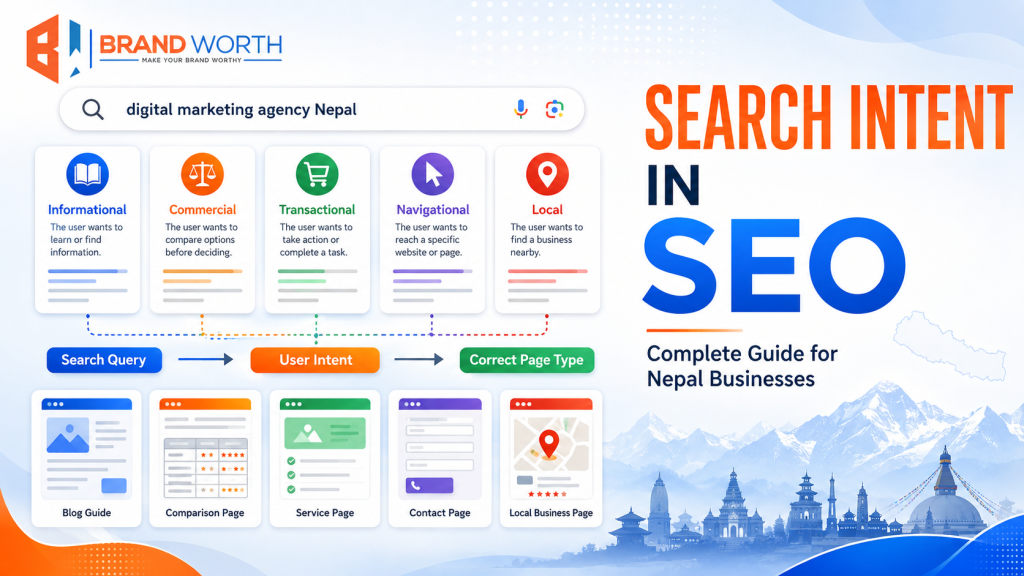
Search intent is the real purpose behind a Google search. It explains whether a person wants to learn something, compare possible solutions, find a specific website, visit a nearby business or complete an action such as buying, booking or contacting a company.
Understanding search intent helps businesses create the right page for the right search.
A business can target a relevant keyword, publish a detailed article and still fail to rank when the page does not match what searchers expect. A blog post may not perform when users want a service page. A heavily promotional landing page may not perform when people are looking for an educational explanation.
This is why search intent should be evaluated during keyword research in Nepal and before any new webpage, service page or article is created.
What Is Search Intent in SEO?
Search intent is the goal a user wants to accomplish by entering a particular query into a search engine.
For example, someone searching for:
- “What is SEO?” wants information.
- “Best SEO agencies in Nepal” wants to compare providers.
- “Hire SEO agency in Kathmandu” may be ready to contact a company.
- “Brand Worth contact” wants to reach a particular brand.
- “Digital marketing agency near me” wants a nearby provider.
Although these searches relate to the same broad subject, they require different answers.
Google explains that when a person searches, its systems attempt to return high-quality information relevant to the query. The results can also vary according to factors such as the user’s location, language and device. Different queries may trigger different result formats, including standard webpages, local results, videos or images. (Google for Developers)
For a broader explanation of how search visibility works, read the complete guide to SEO in Nepal.
Why Is Search Intent Important?
Search intent is important because relevance depends on answering the question the searcher is actually asking—not simply using the same keyword on a page.
Imagine that a company wants to rank for “website development cost in Nepal.”
It publishes a general service page that says:
We create professional websites. Contact us for a quotation.
However, people searching that phrase may expect:
- Typical website price ranges
- Factors affecting development cost
- Ecommerce versus corporate website pricing
- Domain and hosting expenses
- Maintenance costs
- Freelancer versus agency comparisons
- Questions to ask before choosing a developer
The service page contains the keyword, but it does not satisfy the information need behind the query.
A stronger result would be a detailed pricing guide that explains the cost factors clearly and then links readers to a relevant website development service.
Matching intent helps businesses:
- Select the correct page type
- Organize website architecture
- Improve content usefulness
- Reduce keyword cannibalization
- Create clearer titles and headings
- Attract more relevant visitors
- Guide users toward an appropriate next step
- Improve the quality of organic enquiries
Google recommends creating substantial, people-first content that helps visitors achieve their goals rather than publishing content primarily to attract search-engine traffic. (Google for Developers)
Search Intent vs Keyword Meaning
Keyword meaning describes the subject of a query, while search intent describes what the user wants to do with that subject.
Consider the following searches:
| Search query | Subject | Likely intent |
|---|---|---|
| What is digital marketing? | Digital marketing | Learn |
| Digital marketing agency Nepal | Digital marketing | Find a provider |
| Best digital marketing agency Nepal | Digital marketing | Compare providers |
| Brand Worth digital marketing | Digital marketing | Reach a particular company |
| Digital marketing cost in Nepal | Digital marketing | Research pricing |
| Hire digital marketing agency Kathmandu | Digital marketing | Contact or hire |
The subject remains digital marketing, but the expected answer changes.
This is why businesses should not assign every related keyword to one page. Each important page should have:
- One central subject
- One dominant search intent
- One appropriate page type
- One clear audience
- One primary next action
The Main Types of Search Intent
For practical SEO planning, search queries can be divided into informational, commercial, transactional, navigational and local intent.
These categories are useful planning models. Some searches fit clearly into one category, while others contain mixed or uncertain intent.
1. Informational Search Intent
Informational intent means the user wants to learn, understand or solve a problem.
Examples include:
- What is search intent?
- How does SEO work?
- Why is my website not ranking?
- How do I research keywords?
- What is local SEO?
- How can a small business advertise online?
- Why are my Facebook ads not generating leads?
The best content formats commonly include:
- Complete guides
- Tutorials
- Definitions
- Checklists
- Step-by-step articles
- Videos
- Research reports
- FAQs
- Templates
An informational page should answer the question before promoting a service.
For example, a guide about digital marketing should explain the channels, strategy, costs, measurement and implementation considerations. Readers can then explore a broader digital marketing guide for Nepal businesses or a related service when they are ready.
Common Informational Modifiers
Informational searches often contain words such as:
- What
- Why
- How
- When
- Guide
- Tutorial
- Meaning
- Definition
- Examples
- Checklist
- Process
- Tips
- Explained
These modifiers are useful clues, but they should not replace an examination of the actual search results.
2. Commercial-Investigation Intent
Commercial-investigation intent means the user is comparing products, providers, methods or possible solutions before making a decision.
Examples include:
- Best SEO agency in Nepal
- Top advertising companies in Kathmandu
- SEO versus Google Ads
- Freelancer versus digital marketing agency
- Best keyword research tools
- Digital marketing cost in Nepal
- WordPress versus custom website
- Best event management company in Nepal
These users are not always ready to purchase immediately, but they are closer to a decision than someone performing basic research.
Useful content formats include:
- Comparison articles
- Pricing guides
- Vendor-selection guides
- Product comparisons
- Case studies
- Pros-and-cons articles
- Alternatives pages
- Decision frameworks
- Review pages
Commercial content should help readers evaluate their options fairly.
For example, an article comparing an in-house marketing team with an agency should explain:
- Cost
- Skills
- Management requirements
- Scalability
- Creative capacity
- Technology
- Accountability
- Suitable business situations
It should not simply conclude that an agency is always the best option.
Common Commercial Modifiers
Commercial searches may include:
- Best
- Top
- Review
- Comparison
- Versus
- Alternatives
- Cost
- Price
- Affordable
- Package
- Company
- Agency
- Consultant
- Services
A word such as “best” often suggests comparison, but the exact results should still be reviewed.
3. Transactional Search Intent
Transactional intent means the user is prepared to complete or begin a specific action.
The action may include:
- Buying
- Booking
- Registering
- Downloading
- Requesting a quotation
- Calling a business
- Scheduling a consultation
- Applying for a service
Examples include:
- Hire SEO agency Nepal
- Book hotel in Pokhara
- Buy modular kitchen Kathmandu
- Request website quotation
- Register for digital marketing training
- Contact event management company
- Order office furniture online Nepal
The most appropriate pages generally include:
- Product pages
- Service pages
- Booking pages
- Contact pages
- Registration pages
- Ecommerce category pages
- Conversion-focused landing pages
A transactional page should make the next step simple.
It should usually explain:
- What is being offered
- Who it is for
- What is included
- How the process works
- What proof is available
- How to contact, book or purchase
Brand Worth’s digital marketing services, for example, are more appropriate for a service-focused search than a general educational article about digital marketing.
4. Navigational Search Intent
Navigational intent means the user wants to reach a particular website, brand, page or online platform.
Examples include:
- Brand Worth
- Brand Worth contact
- Google Search Console login
- Facebook Business Suite
- Nepal Telecom website
- Daraz seller centre
- YouTube Studio
The user already knows where they want to go.
Businesses usually satisfy navigational intent through:
- A clear homepage
- Accurate branded page titles
- Well-organized navigation
- A visible contact page
- Strong branded search results
- Consistent company information
- Useful sitelinks
Google explains that informative page titles, headings and logical internal links can help its systems understand website structure and generate useful sitelinks. (Google for Developers)
Businesses should monitor branded searches for outdated pages, unofficial profiles, incorrect addresses or poor search-result titles.
Brand Worth maintains dedicated pages for its company information, working approach and contact details to help users reach the appropriate destination.
5. Local Search Intent
Local intent means the user wants a business, service, product or destination connected to a particular location.
Examples include:
- SEO agency Kathmandu
- Advertising agency in Tinkune
- Hospital near me
- Restaurant in Thamel
- Event management company Nepal
- Web developer in Lalitpur
- Furniture shop near Baneshwor
- Hotel in Pokhara Lakeside
Local intent can appear within informational, commercial or transactional searches.
For example:
| Query | Local intent combined with |
|---|---|
| Best restaurant in Thamel | Commercial investigation |
| Dentist near me | Transactional |
| How to reach Pashupatinath Temple | Informational |
| Brand Worth Kathmandu | Navigational |
| Website development company Lalitpur | Commercial or transactional |
Google states that local results are mainly influenced by relevance, distance and prominence. Complete and accurate Business Profile information can help Google understand how well a business matches a local search. (Google Support)
Local-search optimization may involve:
- Google Business Profile
- Service and location information
- Accurate address and contact details
- Customer reviews
- Local photographs
- Maps and directions
- Location-relevant service pages
- Consistent business citations
- Local internal links
Businesses should avoid creating dozens of nearly identical location pages that only replace one city name with another.
6. Mixed Search Intent
Mixed intent occurs when one search can reasonably represent more than one user goal.
Consider the query:
SEO Nepal
The searcher could want:
- A definition of SEO in Nepal
- A list of SEO companies
- An SEO consultant
- SEO training
- Industry information
- A service provider
Google may therefore show a mixture of:
- Educational articles
- Agency pages
- Company lists
- Local results
- Videos
- Discussion pages
Mixed intent is common in short, broad keywords.
A business should not automatically try to satisfy every possible intention on one page. Instead, it should determine:
- Which interpretation is most relevant to the business
- Which page types dominate the results
- Whether the website has enough authority to compete
- Whether a narrower keyword would attract better visitors
A focused page targeting “SEO services in Nepal” may generate more useful enquiries than a broad page targeting only “SEO.”
Search Intent and the Customer Journey
Search intent often changes as a customer moves from recognizing a problem to selecting a solution.
A potential customer may complete several searches before contacting a company.
Awareness Stage
The person recognizes a problem.
Example searches:
- Why is my website not ranking?
- Why are Facebook ads expensive?
- How can I increase hotel bookings?
- Why is my business not appearing on Google Maps?
Useful content:
- Problem explanations
- Diagnostic guides
- Checklists
- Educational videos
Consideration Stage
The person begins researching solutions.
Example searches:
- SEO versus Google Ads
- Best ways to promote a hotel
- Digital marketing agency or in-house team
- Local SEO services Nepal
Useful content:
- Comparisons
- Frameworks
- Strategy guides
- Case studies
Decision Stage
The person is evaluating providers or products.
Example searches:
- Best SEO agency Nepal
- Digital marketing company Kathmandu
- Website development cost Nepal
- Event management agency quotation
Useful content:
- Service pages
- Pricing guides
- Provider-selection guides
- Portfolio pages
- Testimonials
Action Stage
The person is ready to act.
Example searches:
- Contact Brand Worth
- Hire SEO agency Kathmandu
- Request digital marketing proposal
- Book website consultation
Useful content:
- Contact pages
- Booking forms
- Quotation pages
- Clear service pages
A complete digital marketing strategy should support more than one stage of this journey.
How to Identify Search Intent
The most reliable way to identify search intent is to combine keyword wording with an analysis of the current search results.
A modifier can provide a clue, but the search-engine results page shows what type of content Google currently considers relevant.
Step 1: Read the Query Literally
Begin with the words in the search.
Ask:
- Is the user asking a question?
- Is a location included?
- Is a brand named?
- Does the query mention buying or booking?
- Is the user comparing alternatives?
- Is a price or cost requested?
- Is the query broad or highly specific?
For example:
“How much does website development cost in Nepal?”
The words “how much” and “cost” indicate that the user expects pricing information.
Step 2: Search the Keyword
Search the exact phrase using the target location and language where possible.
Observe:
- The types of pages ranking
- The titles and descriptions
- The presence of local results
- People Also Ask questions
- Video results
- Image results
- Product listings
- Forums or discussions
- AI Overviews
- Featured snippets
Google explains that the features displayed on a results page can change according to the query. A search for a nearby repair business may produce local results, while a visually oriented search may show more images. (Google for Developers)
Step 3: Identify the Dominant Page Type
Record what Google is mainly ranking:
- Blog posts
- Service pages
- Product pages
- Category pages
- Location pages
- Videos
- Tools
- Directories
- Homepages
- Government pages
When eight of the first ten results are educational guides, a general service page may not match the dominant intent.
When most results are service or product pages, writing another informational article may not be the strongest choice.
Step 4: Identify the Dominant Content Format
Page type and content format are not always the same.
An informational result could be:
- A complete guide
- A list
- A tutorial
- A definition
- A comparison
- A calculator
- A video
- A template
For example:
- “How to do keyword research” may favour tutorials.
- “Best keyword research tools” may favour lists and comparisons.
- “Keyword difficulty checker” may favour interactive tools.
- “What is keyword difficulty?” may favour definitions and guides.
Step 5: Examine the Common Topics
Review the ranking pages and note the subjects they consistently cover.
If most high-quality results include:
- Definitions
- Examples
- Steps
- Tools
- Mistakes
- FAQs
then users may reasonably expect those areas to be covered.
However, do not simply copy competing structures. Look for information they missed, such as:
- Nepal-specific applications
- Original examples
- Decision frameworks
- First-hand observations
- Useful tables
- Common local challenges
Google recommends original, complete content that provides meaningful value rather than simply summarizing what other pages already say. (Google for Developers)
Step 6: Look for Intent Modifiers
Use modifiers as supporting evidence.
| Modifier | Commonly associated intent |
|---|---|
| What, why, how | Informational |
| Guide, tutorial, examples | Informational |
| Best, top, review | Commercial investigation |
| Versus, alternatives, comparison | Commercial investigation |
| Price, cost, package | Commercial or transactional |
| Buy, book, order | Transactional |
| Hire, contact, quotation | Transactional |
| Near me, in Kathmandu | Local |
| Brand or website name | Navigational |
| Login, dashboard, portal | Navigational |
These associations are not absolute.
“Facebook Ads Manager” may be navigational, while “Facebook Ads Manager guide” is informational.
Step 7: Consider Location and Language
The same phrase may produce different results depending on:
- Country
- City
- Language
- Device
- Search history
- Time
- Market conditions
A person searching “best college” in Kathmandu may see different results from someone searching the same phrase in Pokhara.
This makes Nepal-specific SERP analysis important when content is intended for customers in Nepal.
Step 8: Review Search Console Data
Google Search Console shows which searches are already displaying a website and which pages are being shown.
The Performance report provides query, page, country, device, click, impression, CTR and average-position data. It can also show which URLs appeared for a specific search query. (Google Support)
Use Search Console to identify:
- Unexpected queries
- High-impression, low-CTR searches
- Pages ranking for the wrong intent
- Multiple URLs appearing for one query
- Opportunities to expand a page
- Queries that require a different page
- Changes in search behaviour
A low CTR does not automatically prove an intent problem, but it may indicate that the title, description or page offer does not match what the searcher expects.
The Brand Worth Intent-to-Page Framework
The correct page should match the user’s expectation, preferred format and next logical action.
| Search intent | What the user wants | Best page type | Appropriate next step |
|---|---|---|---|
| Informational | Learn or solve a problem | Guide, tutorial or explainer | Explore related information |
| Commercial investigation | Compare solutions | Comparison, pricing or selection guide | Review options |
| Transactional | Buy, book, register or contact | Product, service or landing page | Complete an action |
| Navigational | Reach a particular destination | Homepage or branded page | Continue to destination |
| Local | Find a nearby business or place | Local service or location page | Call, visit or get directions |
| Mixed | Explore several possible interpretations | Comprehensive but focused page | Choose a relevant pathway |
This framework can guide:
- Keyword mapping
- Website navigation
- Content briefs
- Internal linking
- CTA selection
- Page updates
- Cannibalization decisions
How Search Intent Determines Page Type
A keyword should be assigned to the page type that searchers expect to see.
Use a Blog Article When
- The user wants to understand a topic
- The query asks how or why
- Current results are mostly educational
- The subject requires detailed explanation
- The visitor is early in the journey
Use a Service Page When
- The user is looking for a provider
- The query contains service language
- Commercial pages dominate the results
- The intended action is an enquiry
- The page needs to explain deliverables and process
Use a Product Page When
- The user is looking for a specific product
- Purchase intent is clear
- Specifications, images and availability matter
- The next action is to buy or enquire
Use a Category Page When
- The user wants to browse several related products
- The keyword represents a product class
- Comparison and filtering are useful
Use a Location Page When
- The service is genuinely available in that location
- Local information affects the decision
- The page can provide unique local evidence
- Search results demonstrate local intent
Use a Comparison Guide When
- The user is evaluating different methods or providers
- The search contains “versus,” “best” or “alternatives”
- Decision criteria need explanation
Good search-intent planning should be incorporated into both content strategy and website architecture.
Nepal-Specific Search Intent Considerations
Businesses in Nepal should consider language, geography, trust, seasonality and differences between national and local demand.
English, Nepali and Romanized Nepali Searches
Customers in Nepal may search using:
- English
- Devanagari Nepali
- Romanized Nepali
- Mixed Nepali and English
Examples include:
| Language pattern | Example |
|---|---|
| English | Website development cost in Nepal |
| Nepali | नेपालमा वेबसाइट बनाउने खर्च |
| Romanized Nepali | Nepal ma website banaune cost |
| Mixed | Kathmandu ma best digital marketing agency |
These variations may express similar needs, but the quality and composition of the results can differ.
Do not assume that every version should be placed on the same page. Research actual customer language through:
- Search Console
- Customer enquiries
- Sales-call notes
- Website-search data
- Google suggestions
- Market interviews
Professional market research in Nepal can help when customer language or decision behaviour is unclear.
Kathmandu Is Not the Entire Nepal Market
Search intent may differ across:
- Kathmandu
- Lalitpur
- Bhaktapur
- Pokhara
- Chitwan
- Biratnagar
- Butwal
- Dharan
- Hetauda
- Nepalgunj
- Dhangadhi
A national brand should not build its strategy only around Kathmandu-based assumptions.
Regional differences may affect:
- Language
- Price sensitivity
- Delivery expectations
- Product availability
- Service coverage
- Trust
- Competition
- Preferred contact channels
Seasonal Intent
Some searches become more important during particular periods.
Examples include:
- College admissions
- Trekking and tourism
- Festival shopping
- Tax filing
- School enrollment
- Agriculture
- Wedding services
- Hotel bookings
- Exam results
- Construction activity
A keyword can remain the same while its urgency and expected content change throughout the year.
Trust-Oriented Searches
Customers may use searches to verify a business before contacting it.
Examples include:
- Brand name reviews
- Company address
- Client list
- Contact number
- Project portfolio
- Is the company genuine?
- Company registration
- Agency experience
Businesses should maintain accurate information across their website, social profiles and business listings.
How to Optimize Content for Search Intent
Optimizing for search intent means improving the page’s purpose, structure and usefulness—not simply adding more keywords.
Give the Direct Answer Early
A user should not need to read several promotional paragraphs before receiving an answer.
Begin major sections with:
- A definition
- A clear recommendation
- A direct explanation
- A useful summary
This structure also makes content easier to understand and quote.
Match the Title to the Page
The page title should accurately describe what the visitor will find.
Google says descriptive, concise title text helps users understand why a result is relevant and decide whether to click it. It also warns against keyword stuffing and repetitive boilerplate titles. (Google for Developers)
For example:
Weak title:
SEO Nepal Best SEO Company SEO Services SEO Agency
Better title:
SEO in Nepal: Complete Guide for Businesses
Match the Content Depth to the Query
A definition query may need a short, clear explanation.
A “complete guide” query usually requires:
- Definitions
- Examples
- Steps
- Comparisons
- Mistakes
- Practical recommendations
- FAQs
Longer content is not automatically better. Depth should reflect what is necessary to satisfy the query.
Use an Appropriate CTA
The CTA should match the reader’s stage.
| Search intent | Suitable CTA |
|---|---|
| Informational | Read a related guide |
| Commercial | Compare services or review a case study |
| Transactional | Request a quotation or book a call |
| Local | Call, visit or get directions |
| Navigational | Continue to the requested page |
An informational article should not interrupt every section with “Buy now” or “Contact us.”
Add Contextual Internal Links
Internal links should help readers move naturally between topics and decision stages.
For example:
- A search-intent article can link to keyword research in Nepal.
- An educational SEO guide can link to relevant digital marketing services.
- A market-analysis section can link to consumer and business research.
- An implementation section can link to website development.
Google recommends descriptive, concise anchor text and says every important page should be linked from at least one other page on the website. (Google for Developers)
How to Fix a Page with the Wrong Search Intent
A page with an intent mismatch should be updated, retargeted, merged or replaced according to what the searcher expects.
Situation 1: A Blog Is Ranking Instead of a Service Page
Possible causes include:
- The service page lacks useful information
- The blog matches the query more closely
- Internal links favour the blog
- The service page targets several unrelated services
- The query is more informational than expected
Possible solutions:
- Strengthen the service page
- Clarify the difference between informational and commercial keywords
- Update internal-link anchors
- Narrow the blog’s target
- Link the blog clearly to the service page
Situation 2: A Service Page Targets an Informational Query
Possible solutions:
- Create an educational guide
- Retarget the service page toward a commercial keyword
- Link the guide and service page together
- Keep the sales pitch secondary in the article
Situation 3: Several Articles Target the Same Intent
Possible solutions:
- Merge the strongest material
- Redirect weaker duplicates
- Update internal links
- Assign one primary intent to the consolidated page
- Rework other pages around distinct supporting questions
Situation 4: Search Intent Has Changed
Search results can evolve.
A keyword that once produced educational guides may later show:
- Ecommerce pages
- Videos
- Local businesses
- Fresh news
- AI-generated answers
- Interactive tools
Review important search results periodically and adjust the page when the dominant intent has materially changed.
Search Intent and Keyword Cannibalization
Clear search intent helps prevent multiple pages from competing for the same queries.
Cannibalization can occur when a website publishes:
- “SEO in Nepal”
- “Complete SEO Guide Nepal”
- “Nepal SEO Guide”
- “How SEO Works in Nepal”
If all four pages provide nearly identical information, Google may struggle to identify the intended primary page.
A better structure would be:
| Page | Distinct intent |
|---|---|
| SEO in Nepal | Broad informational pillar |
| Keyword research in Nepal | Keyword-discovery process |
| Search intent in SEO | Intent identification and page matching |
| SEO services in Nepal | Transactional service page |
| SEO cost in Nepal | Commercial pricing research |
| Local SEO in Nepal | Location and Maps visibility |
Each page should support the broader SEO topic without duplicating the same purpose.
Search Intent for AI Overviews and AI Search
AI-search optimization still requires content that accurately addresses the user’s question and related information needs.
Google’s current guidance explains that its generative Search features remain connected to established SEO foundations. It also describes query fan-out, where related searches may be performed to gather information needed to answer a broad or complex question. Google recommends valuable, unique and non-commodity content rather than supposed AI-search shortcuts. (Google for Developers)
For search-intent optimization in AI experiences:
- Answer the central question clearly
- Cover important supporting questions
- Define relevant entities
- Explain comparisons and exceptions
- Include Nepal-specific context
- Support factual claims with reliable sources
- Add original experience and analysis
- Keep important content crawlable
- Use clear headings
- Avoid creating separate pages for every wording variation
For example, a useful article about “SEO cost in Nepal” may need to explain:
- What SEO includes
- Factors affecting cost
- Common pricing models
- Differences between basic and complete SEO
- Expected deliverables
- Warning signs
- Questions to ask a provider
Answering the complete decision need is more useful than repeating “SEO cost Nepal” throughout the page.
How to Measure Search-Intent Performance
Search-intent performance should be measured through visibility, engagement and meaningful business actions.
Review:
- Impressions
- Clicks
- CTR
- Ranking queries
- Landing pages
- Engagement
- Scroll depth
- Contact-form submissions
- Calls
- WhatsApp clicks
- Bookings
- Sales
- Qualified enquiries
Informational Page Metrics
Useful indicators include:
- Growth in relevant non-branded queries
- Engagement with the article
- Visits to related pages
- Email subscriptions
- Assisted conversions
Commercial Page Metrics
Useful indicators include:
- Service-page visits
- Case-study views
- Pricing-page engagement
- Contact clicks
- Qualified enquiries
Transactional Page Metrics
Useful indicators include:
- Purchases
- Form completions
- Phone calls
- Bookings
- Cost per conversion
- Conversion rate
Search Console recommends looking at trends in impressions and clicks rather than relying only on average position. Its reports can also help identify queries with high impressions and low CTR or pages appearing for unexpected searches. (Google Support)
Common Search-Intent Mistakes
Most search-intent mistakes happen when businesses select keywords before deciding what users expect from the page.
Choosing Keywords Only by Search Volume
A high-volume keyword can attract irrelevant visitors.
Business relevance and intent should be considered alongside estimated demand.
Assuming One Modifier Always Means One Intent
“Price” may indicate commercial research or an immediate purchase decision.
The current results provide additional evidence.
Copying the Top-Ranking Page
Competitor analysis is useful, but copying headings does not create original value.
Add local examples, clearer explanations and first-hand insight.
Using a Blog for Every Keyword
Some searches require:
- Service pages
- Product pages
- Category pages
- Location pages
- Tools
- Videos
A blog is only one possible format.
Making Every Page Transactional
Not every visitor is ready to contact a company.
Educational content should educate first.
Mixing Unrelated Intents
A page trying to be a definition, complete guide, service page, pricing guide and contact page may satisfy none of those intentions properly.
Ignoring Local Intent
A generic page may not satisfy someone looking for a nearby provider.
Creating Thin Location Pages
Changing only the city name does not create useful local content.
Ignoring Existing Content
Always review current pages before creating another URL.
Using Aggressive CTAs in Informational Content
The CTA should match the user’s stage and expectations.
Not Reviewing Performance
Search Console can reveal when a page is attracting different queries from those originally intended.
A Practical Search-Intent Audit
A search-intent audit checks whether every important page has a clear purpose and matches the queries showing it.
For each priority URL, record:
| Audit field | Question |
|---|---|
| Primary topic | What is the page about? |
| Primary intent | What does the visitor want? |
| Page type | Is this the correct format? |
| Target audience | Who needs this information? |
| Main query | What search should lead here? |
| Supporting queries | What related needs should it answer? |
| SERP format | What does Google currently reward? |
| Competing URL | Is another internal page targeting the same intent? |
| CTA | What is the appropriate next step? |
| Performance | Are impressions, clicks and conversions improving? |
| Recommended action | Keep, update, merge, redirect or retarget? |
Keep the Page When
- Its purpose is clear
- It matches the results
- It attracts relevant queries
- It provides sufficient value
Update the Page When
- Information is outdated
- Important subtopics are missing
- The title does not match the query
- Engagement or CTR is weak
Merge Pages When
- Several URLs target the same intent
- Each page is individually weak
- Combining them would create a stronger resource
Redirect a Page When
- It is obsolete
- It duplicates a stronger URL
- It no longer has a distinct purpose
Retarget a Page When
- The current keyword is inappropriate
- A better query matches the existing content
- Another page should own the original intent
Search Intent Checklist
Before creating or optimizing a page, confirm:
- What does the searcher want to accomplish?
- Is the query informational, commercial, transactional, navigational or local?
- Does it contain mixed intent?
- What page types dominate the results?
- What content formats dominate?
- Are local results present?
- What important subtopics appear repeatedly?
- What useful information is currently missing?
- Does an existing page already target this intent?
- Is the planned page type appropriate?
- Does the title accurately describe the content?
- Is the answer provided early?
- Does the page include enough depth?
- Is the CTA appropriate for the user’s stage?
- Are relevant internal links included?
- Can performance be measured?
Frequently Asked Questions
What is search intent?
Search intent is the purpose behind a search query. It explains whether the user wants to learn, compare, visit, buy, book, contact or reach a specific website.
What are the main types of search intent?
The main practical categories are informational, commercial investigation, transactional, navigational and local intent. Some searches contain more than one type.
Why does search intent matter for SEO?
It helps businesses create the page format and content users expect. A page may struggle to rank or convert when its purpose does not match the query.
How can I identify search intent?
Read the query, examine the current search results, identify the dominant page type and format, review SERP features and analyse existing Search Console data.
Is search intent more important than search volume?
Both matter, but intent usually determines whether the resulting traffic is relevant. High volume provides limited business value when the search does not match the offering.
Can one keyword have multiple search intents?
Yes. Broad or ambiguous keywords frequently have mixed intent. Google may display several page types when a query has multiple reasonable interpretations.
Can search intent change over time?
Yes. User behaviour, market conditions, new products and changes in search-result formats can affect the dominant intent.
What is informational search intent?
Informational intent means the user wants to learn, understand or solve a problem. Guides, tutorials and explainers commonly satisfy this intent.
What is commercial search intent?
Commercial-investigation intent means the user is comparing products, providers or methods before making a decision.
What is transactional intent?
Transactional intent means the user is prepared to complete or begin an action such as buying, booking, registering or contacting a provider.
What is navigational intent?
Navigational intent means the user wants to reach a specific brand, website, platform or page.
What is local search intent?
Local intent means the user wants information, a product, service or destination connected to a specific geographic location.
Should an informational article include a CTA?
Yes, but the CTA should remain relevant and non-intrusive. It can direct readers to a related guide, service explanation or optional consultation.
How does search intent prevent keyword cannibalization?
Assigning one dominant intent to each page reduces the likelihood that several URLs will compete for the same search query.
Does search intent matter for AI Overviews?
Yes. AI-search systems need useful information that addresses the main question and related sub-questions. Clear structure, original value and strong SEO foundations remain important.
Conclusion
Search intent connects a keyword with the result a person expects.
Keyword research identifies what people search for. Search-intent analysis determines:
- Why they are searching
- What type of page they need
- What information the page should contain
- What action should come next
For Nepal businesses, effective intent analysis should also account for:
- Local geography
- English and Nepali language patterns
- Romanized searches
- Customer trust
- Seasonal demand
- Differences between informational and commercial needs
The central principle is simple:
One dominant intent, one appropriate page and one clear purpose.
When this principle guides content creation, businesses can publish fewer duplicate pages, attract more relevant visitors and build a website that is easier for both customers and search engines to understand.
Brand Worth connects market research, digital marketing and website strategy to help businesses understand customer demand before investing in content. Businesses needing a structured SEO and content roadmap can contact Brand Worth.
Turn the insight into action.
Tell us what you are trying to grow, launch or improve. We will connect you with the right specialist team.
Discuss your project →