
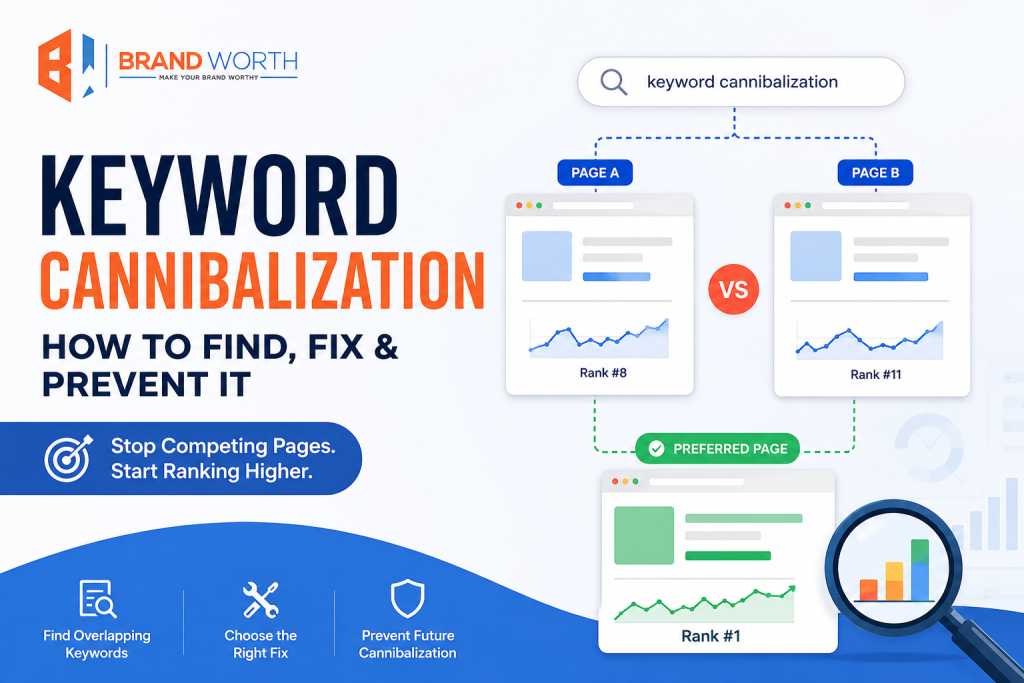
Keyword cannibalization happens when multiple pages on the same website compete for substantially the same search intent in a way that hurts organic performance. However, having two URLs rank for the same keyword does not automatically mean you have a cannibalization problem.
That distinction is important.
As a website grows, related pages naturally begin sharing keywords. An SEO website, for example, may have separate pages about SEO in Nepal, keyword research in Nepal, technical SEO, local SEO, content strategy and SEO services.
Those pages will inevitably mention overlapping terms.
The real question is not:
“Are two pages ranking for the same keyword?”
The better question is:
“Are these pages competing for the same search intent in a way that prevents the website from achieving its full organic potential?”
That is the difference between normal topical overlap and harmful keyword cannibalization.
This guide explains how keyword cannibalization works, how to identify it using Google Search Console and SEO tools, how to choose the correct page to prioritize, and how to fix competing URLs without unnecessarily deleting useful content.
What Is Keyword Cannibalization?
Keyword cannibalization is an SEO issue where two or more pages from the same website target substantially the same keyword cluster and search intent, causing them to compete instead of supporting one another.
For example, imagine a website publishes:
/seo-guide//complete-seo-guide//seo-guide-2026/
If all three pages provide almost the same information for the same audience, Google may have little reason to treat them as separate resources.
Now compare that with:
- SEO guide
- SEO pricing guide
- SEO services page
These pages may all mention terms such as “SEO,” “SEO company,” “SEO strategy” and “SEO services,” but their purposes are different.
The SEO guide serves an informational intent.
The pricing article helps users evaluate costs.
The service page helps potential clients hire an SEO provider.
That is why keyword overlap alone is not enough to diagnose keyword cannibalization.
As Ahrefs explains in its keyword cannibalization guidance, having multiple URLs rank for one query can be perfectly normal when those pages satisfy different intents and are not hurting overall performance.
Is Keyword Cannibalization Always Bad for SEO?
No. Multiple pages ranking for the same or similar keywords are not automatically harmful. Cannibalization becomes a problem when the overlap causes ranking instability, sends users to the wrong page, weakens page authority or reduces overall organic performance.
Consider the following situations.
| Situation | Likely Cannibalization? |
|---|---|
| Two pages rank for the same keyword but serve different intents | Usually no |
| Category and product pages rank for related product searches | Not necessarily |
| Two articles answer almost exactly the same question | Possibly |
| Old and updated versions of the same guide compete | High risk |
| Blog article outranks an important service page | Potential problem |
| Ranking URL keeps changing between two pages | Investigate |
| Two strong pages occupy useful positions in the SERP | Potentially beneficial |
| Parameter URLs duplicate one main page | Mainly a canonicalization issue |
| English and properly translated Nepali pages cover the same topic | Not automatically |
The goal of SEO is therefore not to eliminate every instance of keyword overlap.
The goal is to eliminate unproductive overlap.
Keyword Cannibalization vs Content Cannibalization
Keyword cannibalization refers specifically to pages competing for overlapping search queries and intent, while content cannibalization is the broader problem of publishing several pages that provide substantially the same information or value.
For example:
Keyword cannibalization
Two separate articles target:
- “best SEO tools”
- “best tools for SEO”
If Google treats both phrases as the same search intent, the pages may compete.
Content cannibalization
Five different articles contain nearly identical recommendations for SEO tools even though each article targets a slightly different keyword.
Modern SEO is based on topics, entities, context and search intent—not just exact-match keywords.
That means a website can create cannibalization even when the keywords in the title tags are technically different.
Yoast’s explanation of keyword and content cannibalization makes a similar distinction between keyword overlap and broader content overlap.
What Causes Keyword Cannibalization?
Keyword cannibalization usually develops when websites publish content without maintaining a clear relationship between keywords, search intent and individual URLs.
Several common SEO mistakes create the problem.
Publishing New Content Without Checking Existing Pages
One of the most common causes is simple.
A marketer finds an attractive keyword and creates a new article.
But the website may already have a page satisfying that search intent.
Instead of strengthening the existing resource, the new article becomes another page competing for the same opportunity.
Before publishing any new SEO content, review your existing website, Google Search Console data and keyword map.
A structured keyword research process should identify whether a keyword deserves:
- A new URL
- Expansion of an existing page
- Integration into a broader topic cluster
- A supporting section instead of an entire article
Creating a Separate Page for Every Keyword Variation
Suppose keyword research reveals:
- SEO company Nepal
- SEO agency Nepal
- SEO company in Nepal
- best SEO agency Nepal
- SEO services Nepal
That does not automatically mean the website needs five pages.
If Google interprets these searches as essentially the same intent, one authoritative service page may be stronger than several weaker pages.
Keyword research should therefore include keyword clustering and intent mapping, not simply keyword collection.
Publishing New Versions of Evergreen Articles Every Year
A website might publish:
- SEO Guide 2024
- SEO Guide 2025
- SEO Guide 2026
Historical content can be useful when it genuinely documents a period or provides information users still need.
But repeatedly creating a new URL for an evergreen guide simply because the year changed can create unnecessary duplication.
In many situations, updating the strongest evergreen URL is more effective.
Poor Website Architecture
Keyword cannibalization is often a symptom of a larger website architecture problem.
A well-structured website should clearly define the purpose of:
- Pillar pages
- Supporting blog articles
- Service pages
- Product pages
- Category pages
- Location pages
- Comparison pages
- Landing pages
- Resource pages
For example, Brand Worth’s SEO in Nepal guide should function differently from a commercial SEO services page.
The guide primarily educates.
The service page should help potential clients evaluate and hire an SEO provider.
The keywords may overlap, but the search intent and business purpose should remain clear.
Weak Separation Between Informational and Commercial Intent
This issue is particularly common on agency websites.
Consider:
“Digital marketing in Nepal”
versus:
“Digital marketing agency in Nepal.”
The first query can have strong informational intent.
The second is much more commercial.
If a website creates two pages but both use nearly identical content, headings and calls to action, Google receives weak signals about which page should rank for which audience.
A dedicated digital marketing service page should therefore focus on capabilities, business outcomes, services, process, trust signals and conversion.
Educational articles should primarily solve informational problems.
Repetitive Location Pages
Location-based SEO can also produce cannibalization.
A company may create pages for:
- Kathmandu
- Lalitpur
- Bhaktapur
- Pokhara
- Chitwan
These pages can be useful when there is real location-specific value.
But simply duplicating a page and replacing the city name produces weak differentiation.
Strong location pages should contain unique information such as:
- Local services
- Relevant client examples
- Regional market conditions
- Delivery coverage
- Local case studies
- Location-specific FAQs
- Useful geographic information
Ecommerce Filters and Faceted Navigation
Ecommerce websites frequently generate large numbers of URLs from:
- Filters
- Sort options
- Product attributes
- Categories
- Tags
- Parameters
These pages may create a combination of:
- Duplicate content
- Crawl inefficiency
- Canonicalization problems
- Search-intent overlap
At that point the issue becomes partly editorial and partly technical SEO.
A proper technical SEO audit should examine canonical tags, crawlability, indexation, redirects and URL parameters alongside content targeting.
Confusing Internal Linking
Internal linking helps users and search engines understand relationships between pages.
If one article links the phrase “SEO services” to Page A while several other articles use the same anchor for Page B, the site’s hierarchy becomes less clear.
Google recommends using descriptive, relevant internal anchor text that helps users and Google understand linked pages. See Google’s official link best practices.
Internal linking alone will not solve severe cannibalization, but it can reinforce the intended hierarchy once page roles are clear.
How Does Keyword Cannibalization Affect SEO?
Keyword cannibalization can hurt SEO when several pages divide relevance, links and search visibility that could otherwise be concentrated around one stronger page.
Possible effects include:
- Ranking instability
- The wrong URL appearing in search results
- Multiple pages ranking below their potential
- Internal links being distributed between redundant pages
- External backlinks pointing to different versions of the same resource
- Search engines struggling to identify the strongest page
- Lower conversion rates
- More difficult SEO performance measurement
- Higher content maintenance costs
- Weak topic architecture
However, Google does not require every keyword on a website to belong exclusively to one URL.
A better SEO principle is:
One clear primary purpose for every important page.
Pages can share topics.
They should not unnecessarily duplicate roles.
How Can You Tell If You Actually Have Keyword Cannibalization?
A reliable cannibalization diagnosis requires evidence of overlapping search intent and performance conflict—not simply multiple URLs appearing for one keyword.
A practical way to evaluate a suspected problem is the Brand Worth Cannibalization Confidence Framework.
Evaluate five signals.
1. Query Overlap
Are multiple pages generating impressions for the same important query or keyword cluster?
If yes, continue investigating.
Query overlap alone does not confirm cannibalization.
2. Search Intent Overlap
Would a user consider the pages interchangeable?
Ask:
- Do they answer the same question?
- Do they target the same audience?
- Do they serve the same stage of the buying journey?
- Do they provide substantially the same information?
If two pages solve different problems, they may not need fixing.
3. Ranking Conflict
Look for situations where:
- URL A ranks this week
- URL B ranks next week
- URL A returns later
- Neither page establishes consistent visibility
Frequent URL switching can indicate that Google is struggling to determine which page is the stronger match.
4. Performance Loss
Ask whether having several competing pages appears to be limiting the site’s total organic performance.
Warning signs can include:
- Flat traffic despite increasing content
- Several URLs ranking moderately rather than one ranking strongly
- Declining click-through rate
- Important keywords appearing through the wrong landing page
5. Page-Purpose Conflict
Compare:
- SEO titles
- H1 headings
- Introductions
- Content sections
- Internal anchor text
- Calls to action
- Search intent
- Page type
If two URLs communicate essentially the same purpose, there is a strong case for consolidation or differentiation.
Cannibalization Confidence Score
| Signals Present | Interpretation |
|---|---|
| 0–1 | Probably normal topical overlap |
| 2–3 | Needs manual investigation |
| 4–5 | Strong cannibalization candidate |
This is a practical prioritization framework, not an official Google metric.
The purpose is to prevent marketers from making destructive SEO changes based only on keyword overlap.
How to Find Keyword Cannibalization in Google Search Console
Google Search Console is one of the best free tools for identifying potential keyword cannibalization because it allows you to review which URLs receive visibility for a particular query.
According to Google Search Console’s Performance report documentation, you can select a query and then review the Pages report to see which URLs appeared for that search.
Step 1: Open the Search Results Performance Report
Go to:
Google Search Console → Performance → Search Results
Select a useful date range.
For established websites, comparing the last three to six months can provide more meaningful patterns than looking at only a few days.
Step 2: Open the Queries Report
Review queries with:
- High impressions
- Commercial importance
- Strong lead-generation potential
- Declining clicks
- Ranking volatility
Prioritize keywords that matter to the business.
Fixing cannibalization for a keyword with ten annual impressions should not take priority over a commercial search generating thousands of impressions.
Step 3: Select the Target Query
Click a keyword you want to investigate.
Search Console will filter the Performance report around that query.
Step 4: Open the Pages Tab
Now review which URLs generated impressions for that keyword.
Finding several URLs gives you a list of candidates to investigate.
It does not prove that every listed URL must be consolidated.
Step 5: Compare the Pages
Open each page and ask:
- Do they serve the same search intent?
- Do they target the same user?
- Is one clearly stronger?
- Is the wrong page ranking?
- Are both pages necessary?
- Could the pages be combined?
Step 6: Examine Performance Trends
Look for:
- Ranking URL switching
- Falling clicks
- Declining impressions
- Flat ranking performance
- One page gaining visibility while another loses it
- A commercial keyword sending users to an informational article
Google recommends focusing on click and impression trends rather than relying solely on average position.
Important Google Search Console Limitation
Search Console frequently attributes performance data to canonical URLs, so technical duplicate URLs may not always appear independently in Performance reports.
Google explains this behavior in its Search Console canonical URL documentation.
For technical duplication issues, supplement Search Console Performance data with:
- URL Inspection
- Site crawling
- Sitemap review
- Canonical tag checks
- Internal link analysis
- Indexation review
How to Find Keyword Cannibalization with Google Search
Google’s site: search operator can quickly surface related pages from your own domain, although it should be used as a discovery method rather than a definitive diagnostic tool.
Search:
site:yourdomain.com "target topic"
For example:
site:thebrandworth.com "keyword research"
Review the pages that appear.
Ask:
- Are several articles nearly identical?
- Are old versions of guides still indexed?
- Are service pages and blogs targeting the same purpose?
- Are multiple location pages offering nearly identical content?
Tools such as Semrush and Yoast also recommend manual site searches as one way to discover overlapping content.
How to Find Keyword Cannibalization with Ahrefs or Semrush
SEO platforms can identify keywords associated with multiple URLs at scale, making them especially useful for large websites.
Tools such as Ahrefs and Semrush can help identify:
- Multiple ranking URLs
- Ranking changes
- Keyword overlap
- Historical URL switching
- Competing pages
- Ranking distribution
But automated reports still require human analysis.
For every suspected issue, check:
- Search intent
- Page type
- Ranking history
- Traffic
- Backlinks
- Internal links
- Conversion purpose
SEO tools can identify the overlap.
They cannot always decide whether that overlap is beneficial or harmful.
Which Cannibalized Page Should You Keep?
The best page to keep is the URL with the strongest combination of search-intent fit, organic performance, backlinks, content quality, conversion potential and long-term strategic value.
Do not automatically choose:
- The oldest page
- The newest page
- The longest article
- The URL containing the exact keyword
Compare the pages properly.
| Factor | What to Evaluate |
|---|---|
| Search intent | Which URL best answers the query? |
| Rankings | Which URL performs more strongly? |
| Clicks | Which page attracts meaningful organic traffic? |
| Backlinks | Which page has stronger external authority? |
| Internal links | Which page is integrated better across the website? |
| Conversions | Which page produces business value? |
| Content quality | Which provides the strongest foundation? |
| URL structure | Which URL is more evergreen and logical? |
| Historical performance | Does one page have valuable search history? |
| Strategic role | Which URL fits the long-term site architecture? |
In many cases, the best solution is to keep the stronger URL and integrate valuable information from the weaker page.
How to Fix Keyword Cannibalization
The correct solution depends on the reason the pages are competing. There is no single fix that should be applied to every cannibalization problem.
Use the following decision guide.
| Situation | Recommended Solution |
|---|---|
| Pages serve clearly different intents | Keep and differentiate |
| Two articles serve essentially the same intent | Merge |
| An old page has been permanently replaced | 301 redirect |
| Genuine duplicate URLs must remain accessible | Canonicalize |
| Page must exist but should not appear in search | Consider noindex |
| Pages are different but internal hierarchy is unclear | Improve internal linking |
| One page is targeting the wrong search intent | Rewrite or retarget |
| Both pages perform strongly for different needs | Leave them alone |
Fix 1: Merge Competing Pages
Merging is often the best solution when two useful pages contain overlapping information and serve essentially the same search intent.
Suppose a website has:
/keyword-cannibalization-guide/
and
/how-to-fix-keyword-cannibalization/
If both pages provide almost the same information, one comprehensive resource may be stronger.
How to merge competing pages
- Select the strongest URL.
- Identify useful information on both pages.
- Combine unique insights into the preferred page.
- Remove repetitive sections.
- Improve the article structure.
- Redirect the retired URL.
- Update internal links.
- Update the XML sitemap.
- Check canonical tags.
- Monitor Search Console.
Do not simply copy and paste one article underneath another.
The final resource should be more useful, clearer and better structured than either original page.
Fix 2: Use a 301 Redirect
Use a permanent redirect when one page is being retired and another URL is the most relevant replacement.
Google explains that permanent redirects such as 301 and 308 redirects are strong signals for selecting the destination URL as canonical. See Google’s redirect documentation.
Common use cases include:
- Combining two articles
- Replacing outdated content
- Consolidating duplicate landing pages
- Migrating an old URL to a better permanent URL
After implementing the redirect:
- Update internal links
- Remove the old URL from the sitemap
- Check the destination canonical
- Avoid redirect chains
- Test the redirect
- Monitor indexing
Never redirect an unrelated page just because it has backlinks.
The new destination should genuinely satisfy the original user’s need.
Fix 3: Differentiate Search Intent
If both pages are useful, keep them but make their purpose clearly different.
For example:
Page A: Keyword Research in Nepal
Purpose:
Help marketers discover, evaluate, cluster and map search queries.
Brand Worth already has a dedicated keyword research guide serving this purpose.
Page B: Keyword Cannibalization
Purpose:
Help marketers diagnose and resolve conflicts between existing pages.
These subjects are closely related.
They still deserve separate pages because they solve different problems.
Differentiation should appear in:
- Title tag
- H1
- Introduction
- Search intent
- Content sections
- Examples
- Internal links
- CTA
- Structured data
- Page positioning
Changing only the target keyword is not enough.
The actual purpose must change.
Fix 4: Use Canonical Tags for Genuine Duplicate Pages
Canonical tags should be used when duplicate or substantially similar URLs must remain accessible but one URL should be treated as the preferred version.
Google describes canonicalization as the process of choosing the representative URL from duplicate or highly similar pages. See Google’s canonicalization documentation.
Typical use cases include:
- URL parameters
- Tracking variations
- Duplicate category paths
- Sort/filter variations
- Print-friendly versions
- Similar technical duplicates
Google treats:
- Redirects as strong canonical signals
rel="canonical"as strong canonical signals- Sitemap inclusion as a weaker signal
A canonical tag is not the correct solution simply because two legitimate blog posts mention the same keyword.
If both pages deserve independent indexing, differentiate them.
If they essentially serve the same purpose, consolidation is usually worth evaluating.
Fix 5: Use Noindex Carefully
Use noindex only when a page genuinely should remain accessible to users but should not appear in Google Search.
Google defines noindex as a directive telling Google not to index a page or display it in search results. See Google’s guidance on controlling indexed content.
Potential examples include:
- Internal utility pages
- Certain search-result pages
- Low-value generated pages
- Filter pages without organic search value
- Internal campaign pages
Do not noindex a valuable article merely because it currently competes with another page.
First determine whether the content should be:
- Improved
- Merged
- Repositioned
- Redirected
- Differentiated
Fix 6: Improve Internal Linking
Internal linking can reinforce which page should be considered the primary resource for a topic.
Suppose ten Brand Worth articles mention “keyword cannibalization.”
Those contextual links should generally point toward this dedicated guide instead of being distributed inconsistently across several overlapping resources.
Likewise, this guide should link upward to relevant parent resources such as:
This creates a logical topic cluster.
Google’s SEO Starter Guide recommends clear navigation and relevant internal links that help users and Google understand site structure.
Fix 7: Rewrite or Retarget One Page
Retarget a page when it has enough value to remain indexed but its current purpose overlaps too heavily with another URL.
Imagine two posts target:
- Digital marketing strategy
- Digital marketing plan
If SERP research shows that Google treats those searches as the same intent, publishing two broad guides may not provide enough differentiation.
One could instead become:
Digital Marketing Campaign Planning Checklist for Nepal
That new page would need genuinely different content, search intent and value.
Simply replacing keywords without changing the actual content will not fix cannibalization.
Fix 8: Delete Content That Has No Strategic Value
Deleting can be appropriate when a page is thin, outdated, redundant and provides no meaningful traffic, backlinks, conversions or historical value.
Before deleting any page, evaluate:
- Organic traffic
- Backlinks
- Referral traffic
- Conversions
- Internal links
- Rankings
- Historical importance
- Whether a relevant replacement exists
If there is a highly relevant replacement, use a permanent redirect.
If there is no relevant replacement, do not automatically redirect the URL to the homepage.
What Should You Avoid When Fixing Keyword Cannibalization?
The biggest mistake is treating every instance of keyword overlap as an SEO emergency.
Avoid the following actions.
Do Not Delete Pages Without Evidence
If two URLs rank strongly and satisfy different search needs, deleting one could reduce visibility rather than improve it.
Do Not Canonicalize Different Articles
Canonical tags are intended for duplicate or very similar content.
Do not canonicalize two genuinely different resources simply because they share several keywords.
Do Not Redirect Every Removed Page to the Homepage
Redirects should preserve relevance.
A user looking for a keyword research guide should not suddenly land on a generic homepage.
Do Not Change Successful URLs Just to Insert Keywords
If an existing page already performs well, changing the URL simply to make it more keyword-rich can create unnecessary SEO migration risk.
Do Not Create Another Article Before Checking Existing Content
Before approving new content, search your own website first.
Review:
- Current articles
- Service pages
- Search Console queries
- Keyword mapping
- Topic clusters
This simple step prevents a large percentage of future cannibalization.
Do Not Remove Useful Mentions From Pillar Pages
A broad SEO in Nepal guide can still discuss keyword cannibalization.
It should simply provide a concise explanation and link to the dedicated guide for deeper coverage.
That is good internal architecture.
Cannibalization becomes more likely when both URLs attempt to provide the complete answer to exactly the same search intent.
How to Prevent Keyword Cannibalization
The most effective way to prevent keyword cannibalization is to assign every important search-intent cluster to a defined URL before content creation begins.
Build a Keyword-to-Page Map
Your SEO content map should include:
- Primary keyword cluster
- Secondary keywords
- Search intent
- Page type
- Existing URL
- Funnel stage
- Conversion goal
- Supporting content
- Internal links
- Last updated date
This makes it easier to decide whether a new keyword requires a new page or belongs inside an existing resource.
Check Existing Content Before Publishing
Before a new article is approved:
- Search your CMS.
- Run a Google
site:search. - Review Search Console.
- Check existing target keywords.
- Review related URLs.
- Compare search intent.
- Decide whether the existing page should be updated instead.
Brand Worth uses this same principle when structuring broader SEO strategies for businesses in Nepal.
Build Topic Clusters
Instead of creating isolated blog posts, build structured topic clusters.
For example:
SEO Pillar
Supporting resources:
- Keyword Research in Nepal
- Keyword Cannibalization
- Technical SEO in Nepal
- Internal Linking
- Search Intent
- Keyword Mapping
- Content Auditing
- Canonical Tags
- SEO Pricing
- Local SEO
Every page can discuss related concepts while still serving its own primary intent.
Audit Content Regularly
Websites rarely remain perfectly organized forever.
Quarterly or biannual content reviews can identify:
- Duplicate articles
- Declining pages
- Outdated resources
- Weak internal links
- Overlapping keywords
- Search-intent drift
- Pages worth consolidating
- Missing content opportunities
A growing content library requires maintenance as well as publication.
Brief Writers Around Search Intent
Do not give writers only a keyword.
An SEO content brief should answer:
What does the user want?
Why should this page exist?
Which existing pages discuss this subject?
How will this page be different?
Which page should it internally link to?
What unique information will it contribute?
Those questions are far more effective at preventing keyword cannibalization than setting an arbitrary keyword-density target.
Keyword Cannibalization Examples for Nepal
Nepali websites frequently face cannibalization when businesses create repetitive service, location or informational pages to target every visible keyword variation.
Example 1: SEO Website
A company publishes:
- SEO in Nepal
- SEO services in Nepal
- Best SEO company in Nepal
A stronger architecture could be:
SEO in Nepal
Informational pillar
SEO Services in Nepal
Commercial service page
Best SEO Company in Nepal
Only create a separate page if SERP research proves that the commercial-investigation intent is sufficiently different.
Do not create pages simply because keyword tools show different phrases.
Example 2: Digital Marketing Location Pages
A digital marketing company may create:
- Digital marketing agency Kathmandu
- Digital marketing agency Lalitpur
- Digital marketing agency Bhaktapur
Separate pages can work if they contain genuinely local value.
If every page contains the same text with only the city changed, the website is creating weak differentiation.
A stronger strategy might use one authoritative digital marketing service page supported by genuinely useful regional content where demand justifies it.
Example 3: Nepali and English Content
Publishing both Nepali and English versions of content does not automatically mean the pages are cannibalizing each other.
If they are properly translated and serve different language audiences, both may have valid search purposes.
Google’s canonicalization guidance explains that localized and translated pages can be treated separately when their content genuinely serves different language users.
Example 4: Ecommerce Websites
Imagine an ecommerce website has:
- Laptop category
- Gaming laptop category
- Individual gaming laptop product pages
- Best gaming laptops in Nepal blog
These URLs naturally share keywords.
But their purposes are different.
Category: Browse multiple products
Subcategory: Browse a specific product type
Product page: Evaluate or purchase one product
Blog article: Research and compare options
The objective is not zero keyword overlap.
It is clear search intent architecture.
Does Keyword Cannibalization Affect Google AI Overviews and AI Search?
Clear page purpose, useful information and strong technical SEO can support visibility in AI-driven search experiences, but there is no separate Google keyword cannibalization requirement specifically for AI Overviews.
Google states in its AI features and your website documentation that the same foundational SEO practices used for traditional Google Search remain relevant to AI Overviews and AI Mode.
There are no special technical requirements guaranteeing inclusion.
The practical lesson for SEO, AEO and GEO is therefore straightforward:
- Make each important page useful
- Give every page a clear purpose
- Avoid unnecessary duplication
- Create logical internal links
- Maintain crawlability and indexability
- Publish original information
- Use descriptive headings
- Support factual claims with reliable sources
- Keep technical SEO healthy
Clear website architecture helps search engines and AI systems understand how your resources relate to each other.
But fixing keyword cannibalization should never be presented as a guaranteed method for earning AI citations.
How Long Does It Take to Recover After Fixing Keyword Cannibalization?
There is no fixed recovery period because results depend on crawling, indexing, page authority, competition, the scale of changes and the quality of the surviving page.
After consolidating or restructuring pages, Google needs time to:
- Recrawl URLs
- Process redirects
- Reevaluate canonical signals
- Reassess content
- Update ranking systems
Google explains in its canonicalization troubleshooting documentation that canonical changes may require time to be processed.
Instead of expecting an immediate ranking jump, track the following over time:
- Preferred URL indexation
- Query impressions
- Clicks
- CTR
- Ranking stability
- Total organic traffic
- Leads or conversions
- Competing URLs
- Internal-link changes
- Backlink continuity
How Do You Know Whether a Cannibalization Fix Worked?
A successful fix should improve total performance around the target search intent—not merely make one URL disappear from Google.
Measure:
| Metric | What to Check |
|---|---|
| Ranking URL | Is the intended page ranking? |
| Clicks | Did total organic clicks improve? |
| Impressions | Is visibility growing or stabilizing? |
| CTR | Is the preferred page earning more clicks? |
| Rankings | Is performance more consistent? |
| Conversions | Are users completing useful actions? |
| URL switching | Has ranking volatility decreased? |
| Indexation | Is Google indexing the correct URL? |
Google Search Console provides click, impression, CTR and average-position data through its Performance report.
Do not evaluate success using only one ranking position.
A page that ranks slightly lower but generates significantly more qualified conversions may still be the better business outcome.
Keyword Cannibalization Audit Checklist
Use this checklist whenever the wrong page ranks, organic performance becomes unstable or several URLs appear to target the same opportunity.
Discovery
- Identify the important keyword cluster
- Check Google Search Console
- Review all ranking URLs
- Run a
site:search - Check Ahrefs, Semrush or another SEO platform
- Compare titles and H1s
- Review the keyword map
Diagnosis
- Compare search intent
- Compare page type
- Review ranking history
- Check clicks and impressions
- Review backlinks
- Check internal links
- Compare conversion goals
- Determine whether performance is actually being harmed
Decision
Choose one:
- Leave alone
- Differentiate
- Merge
- Redirect
- Canonicalize
- Noindex
- Delete
- Rewrite
- Retarget
Implementation
- Preserve valuable content
- Update internal links
- Implement redirects correctly
- Review canonical tags
- Update the sitemap
- Test affected URLs
- Request reindexing where appropriate
Verification
Monitor:
- Preferred URL
- Organic clicks
- Impressions
- CTR
- Conversions
- Ranking stability
- Indexation
- Competing URLs
Frequently Asked Questions About Keyword Cannibalization
What is keyword cannibalization?
Keyword cannibalization occurs when multiple pages from the same website compete for substantially the same search intent in a way that reduces or misdirects organic performance.
Is keyword cannibalization bad for SEO?
It can be, but multiple URLs ranking for one keyword are not automatically harmful. The issue becomes important when pages serve the same intent and cause ranking instability, diluted visibility or the wrong page to rank.
How do I check keyword cannibalization?
Use Google Search Console. Filter the Performance report by an important query and open the Pages tab to identify URLs receiving impressions for that search. Then manually compare their search intent and performance.
Can two pages rank for the same keyword?
Yes. Two pages can rank for the same query without creating cannibalization when they serve different search intents or both contribute valuable search visibility.
How do I fix keyword cannibalization?
Depending on the cause, you may merge pages, redirect an obsolete URL, differentiate the search intent, improve internal linking, canonicalize genuine duplicates, retarget content or selectively use noindex.
Should I delete cannibalized pages?
Not automatically. First review backlinks, traffic, rankings, conversions, content quality and search intent. Valuable content may be better merged or repositioned.
Should I use canonical tags for keyword cannibalization?
Canonical tags are appropriate for duplicate or substantially similar URLs where one should be treated as the preferred version. They are not a universal solution for two legitimate pages serving different purposes.
Is keyword cannibalization the same as duplicate content?
No. Duplicate content refers to identical or highly similar content. Keyword cannibalization refers to competing search intent. They can occur together but are different SEO problems.
Can internal links contribute to keyword cannibalization?
Poor internal linking can make page hierarchy less clear. Internal links should consistently support the intended primary resource for each topic.
Why is the wrong page ranking for my keyword?
The ranking page may currently match Google’s interpretation of search intent better, have stronger links, contain more relevant content or receive stronger internal signals. Compare the competing pages before making changes.
Can a blog post cannibalize a service page?
Yes. This often happens when both target the same query without clearly separating informational and commercial intent.
A blog should usually educate, while a commercial page such as Brand Worth’s digital marketing service page should help potential clients evaluate services and take action.
How do I prevent keyword cannibalization?
Maintain a keyword-to-page map, check existing content before publishing, define a primary intent for every important URL, build structured topic clusters and conduct regular content audits.
Is ranking fluctuation always caused by cannibalization?
No. Rankings change for many reasons. URL switching is only one possible signal and should be evaluated alongside search-intent overlap, traffic patterns and page purpose.
Does keyword cannibalization affect AI Overviews?
There is no separate Google cannibalization rule specifically for AI Overviews. Google’s guidance says foundational SEO practices remain relevant to its AI-powered search experiences.
How often should websites check for keyword cannibalization?
Websites publishing frequently should monitor important search queries continuously and perform deeper content audits every three to six months.
Final Takeaway
Keyword cannibalization is not simply the presence of similar keywords across a website. It is a page-purpose problem that occurs when overlapping URLs compete in a way that weakens or misdirects organic performance.
That distinction changes how the problem should be handled.
Do not automatically delete a page because two URLs rank for the same keyword.
Instead:
- Identify the keyword cluster.
- Review the ranking URLs.
- Compare their search intent.
- Determine whether performance is actually being harmed.
- Decide which page should own the primary intent.
- Choose the least destructive solution.
- Strengthen internal linking and website architecture.
- Measure total organic performance after the change.
A mature SEO strategy does not attempt to create one URL for every keyword variation.
It creates the right page for every meaningful search intent.
If your website has accumulated overlapping service pages, competing blog articles, duplicate keyword targets or unstable organic rankings, Brand Worth can help identify the underlying problem through SEO strategy, keyword research, technical analysis, content architecture and website optimization.
Explore Brand Worth’s SEO in Nepal guide, learn how to build a stronger keyword research strategy, review the fundamentals of technical SEO, or contact Brand Worth to discuss an SEO audit for your website.
Turn the insight into action.
Tell us what you are trying to grow, launch or improve. We will connect you with the right specialist team.
Discuss your project →