
Which Is the Best Digital Marketing Agency in Nepal?
The best digital marketing agency in Nepal is not automatically the company with the most followers, the biggest client-logo wall, the cheapest monthly package or the boldest claim of being “No. 1.”
The right agency is the one that can understand your business problem, identify the channels most likely to solve it, execute those channels properly, protect your digital assets and measure whether marketing is creating meaningful business results.
For one company, that may mean SEO and Google Ads.
For another, it may mean social media, video production and Meta advertising.
A national brand launch may require research, creative strategy, production, digital advertising, traditional media, PR and events working together.
So when businesses search for the top digital marketing agency in Nepal, the better question is:
Which agency has the right combination of strategy, capability, proof, measurement and execution for our business?
This guide explains how to evaluate digital marketing agencies in Nepal, what separates strong agencies from ordinary service providers, which services businesses may need, what to compare before signing a contract and when an integrated agency such as Brand Worth may be the right fit.
If you first want to understand the channels themselves, read Brand Worth’s complete guide to digital marketing in Nepal.
What Makes a Top Digital Marketing Agency in Nepal?
A top digital marketing agency should be able to connect marketing activity with an actual business objective.
The agency should not begin with:
“How many posts do you want every month?”
It should begin with questions such as:
- What are you trying to achieve?
- Who is the customer?
- What influences that customer?
- Where does the buying journey begin?
- What is preventing growth today?
- Which marketing channels are already working?
- What can realistically be measured?
- What should happen after a lead is generated?
A useful agency evaluation can be based on the following areas:
| Factor | What You Should Evaluate |
|---|---|
| Strategy | Does the agency understand the business problem before recommending channels? |
| Digital capability | Can it execute SEO, paid media, social, content and analytics when required? |
| Creative capability | Can it produce communication strong enough to compete for attention? |
| Website capability | Can it improve landing pages and conversion problems when necessary? |
| Measurement | Can it connect campaigns with leads, sales or other meaningful KPIs? |
| Experience | Can it show relevant work, methodology or evidence? |
| Team | Do you know who will actually execute the work? |
| Ownership | Will your business retain appropriate access to its accounts and data? |
| Transparency | Are agency fees, media spending, production and third-party costs clear? |
| Integration | Can multiple marketing activities work as one strategy when needed? |
The best agency for a startup may therefore be very different from the best agency for a national corporate brand.
“Best” should describe fit and capability—not simply a marketing claim.
The Brand Worth 7-Point Agency Fit Framework
Before comparing digital marketing agencies in Nepal, Brand Worth recommends evaluating each shortlisted agency across seven areas.
| Area | Core Question |
|---|---|
| 1. Strategy | Does the agency understand the business problem before recommending channels? |
| 2. Capability | Does it have the skills required to achieve the objective? |
| 3. Proof | Can it demonstrate relevant work, methodology or outcomes? |
| 4. Ownership | Will your business retain appropriate control of accounts and data? |
| 5. Measurement | Can the agency connect marketing activity with meaningful KPIs? |
| 6. Commercials | Are fees, media spending, production and exclusions transparent? |
| 7. Working Fit | Can both teams communicate, approve and execute effectively together? |
This is a Brand Worth agency-selection framework, not an industry certification or Google metric.
Its purpose is to make agency comparison less subjective.
An agency does not need to be perfect in every area.
But weaknesses involving account ownership, transparency, measurement or unsupported guarantees deserve much more attention than minor differences in the number of monthly posts included in a proposal.
What Does a Digital Marketing Agency in Nepal Do?
A digital marketing agency plans, executes and measures marketing activities across online channels.
Depending on the agency, services may include:
- Digital marketing strategy
- SEO
- Local SEO
- Google Ads
- Meta advertising
- Social media marketing
- Content marketing
- Graphic design
- Video production
- Influencer marketing
- TikTok campaigns
- Website optimization
- Website development
- Landing-page development
- Email marketing
- Analytics
- Conversion tracking
- Performance marketing
- Online reputation management
A full-service digital marketing agency may handle several of these disciplines.
An integrated agency may go further by connecting digital marketing with:
- Market research
- Brand strategy
- Traditional advertising
- Media buying
- Public relations
- Photography
- Film and video production
- Events
- Brand activations
Brand Worth’s digital marketing services in Nepal handles digital strategy, social media, SEO, Google Ads, performance marketing, influencer campaigns and digital content, with other Brand Worth teams available when a campaign requires research, production, advertising, media, website development or events.
Which Digital Marketing Services Does Your Business Actually Need?
The correct digital marketing mix depends on the problem you are trying to solve.
| Business Goal | Capabilities You May Need |
|---|---|
| Generate immediate search enquiries | Google Ads, landing pages, conversion tracking |
| Build long-term Google visibility | SEO, content, technical optimization |
| Reach nearby customers | Local SEO, Google Business Profile, location targeting |
| Increase ecommerce sales | Paid media, SEO, CRO, remarketing |
| Generate B2B leads | SEO, Google Ads, content, landing pages |
| Increase admissions | Search Ads, Meta campaigns, video, landing pages |
| Launch a new product | Research, campaign strategy, creative, video, paid media |
| Build a new brand | Research, positioning, branding, creative strategy |
| Reach the Nepali diaspora | Audience research, international targeting, content and paid media |
| Run a national campaign | Research, advertising, production, media, digital and events |
A good digital marketing company should therefore be willing to tell you that you do not need a particular service when it does not support your objective.
Selling every available service is not strategy.
Selecting the right combination is.
SEO and Search Visibility
SEO helps businesses become visible when customers actively search for products, services, solutions or information.
A professional SEO strategy can include:
- Keyword research
- Search-intent analysis
- Technical SEO
- Website architecture
- On-page SEO
- Content strategy
- Local SEO
- Internal linking
- Authority development
- Search performance measurement
- Conversion optimization
When evaluating SEO capability, ask:
- How will keyword opportunities be researched?
- How will search intent be identified?
- Which page should target each important query?
- How will technical SEO be audited?
- How will content quality be improved?
- How will local SEO be handled?
- How will keyword cannibalization be prevented?
- How will organic enquiries be measured?
Do not evaluate an SEO provider simply by how many keywords it promises to rank.
No agency controls Google’s organic rankings.
Google itself recommends creating helpful, reliable, people-first content and making pages clear and useful rather than producing content primarily to manipulate rankings.
For a deeper explanation, read Brand Worth’s SEO in Nepal guide.
Google Ads and Performance Marketing
Google Ads can be effective when customers already search for a product or service and a business wants to capture that demand immediately.
A strong paid-search strategy may include:
- Commercial keyword research
- Search-term analysis
- Negative keywords
- Geographic targeting
- Ad copy
- Conversion tracking
- Landing pages
- Call tracking
- Bid management
- Campaign optimization
Before hiring an agency for Google Ads, ask:
- What counts as a conversion?
- Which locations will be targeted?
- How will irrelevant searches be excluded?
- Will we have access to the Google Ads account?
- How will lead quality be evaluated?
- Does the campaign require dedicated landing pages?
- How will performance be reported?
Do not judge paid advertising only by clicks.
One hundred relevant visitors who generate qualified enquiries can be more valuable than thousands of low-intent clicks.
Social Media Marketing
Social media marketing should have a clear role in the customer journey.
It may support:
- Brand awareness
- Community building
- Product education
- Trust
- Video discovery
- Lead generation
- Customer communication
- Remarketing
- Sales
Before appointing a social media agency, understand:
- Who the target audience is
- Which platforms actually matter
- What type of content the audience needs
- Why each content category exists
- How much content requires paid distribution
- How leads will be handled
- Which metrics define success
A large follower count alone does not make an agency one of the best digital marketing agencies in Nepal.
The question is whether its social strategy contributes to the wider marketing objective.
Meta Advertising
Meta advertising across platforms such as Facebook and Instagram can support different stages of the customer journey.
Depending on the business, campaigns may target:
- Awareness
- Video views
- Website traffic
- Leads
- Messages
- Remarketing
- Ecommerce purchases
Effective Meta advertising requires more than repeatedly boosting posts.
Campaigns should connect:
Objective → Audience → Creative → Offer → Landing experience → Measurement → Optimization
Your company should also retain appropriate administrative control of its Meta business assets and advertising accounts.
Content and Creative Production
Digital marketing performance depends heavily on creative execution.
Businesses may need:
- Graphic design
- Social content
- Short-form video
- Photography
- Product demonstrations
- Testimonials
- Explainer videos
- Corporate films
- TV commercials
- Podcasts
- Event content
- Campaign concepts
An agency that can buy media but cannot consistently produce strong creative may require additional suppliers.
Brand Worth’s Production House can work alongside its digital team when campaigns require professional film, video, photography or audio production.
This is especially useful when the same campaign must work across social media, YouTube, digital advertising, television, events and other formats.
Website and Landing-Page Optimization
Marketing cannot permanently compensate for a weak website.
A campaign may generate traffic but still fail because of:
- Slow loading
- Weak mobile experience
- Confusing navigation
- Poor forms
- Unclear services
- Weak trust signals
- Missing calls to action
- Poor landing-page relevance
- Tracking problems
Before increasing the media budget, ask:
Does the destination deserve more traffic?
Brand Worth’s Website Development team can support custom websites, WordPress/CMS development, ecommerce, hosting, performance and website improvements when digital campaigns require development support.
Influencer Marketing
Influencer marketing can help brands borrow attention and trust from creators who already have relevant audiences.
But follower count should not be the only selection factor.
Evaluate:
- Audience relevance
- Geographic reach
- Engagement quality
- Content style
- Brand fit
- Past partnerships
- Usage rights
- Deliverables
- Reputation
- Measurement method
A smaller creator with a highly relevant audience may outperform a much larger creator whose followers have little connection to the product.
Research Before Marketing
One characteristic that can separate a strong marketing agency from an execution-only supplier is what happens before content or advertising begins.
Useful research can include:
- Customer interviews
- Competitor analysis
- Search behaviour
- Audience segmentation
- Brand perception
- Purchase barriers
- Regional differences
- Language preferences
- Price sensitivity
- Market trends
Before approving a major campaign, management should be able to answer:
- Who are we trying to influence?
- What does that customer care about?
- Why would they choose us?
- What stops them from choosing us?
- Which alternatives are they comparing?
- Where do they search?
- Which platforms influence them?
- Which language should communication use?
Brand Worth’s Market Research team supports consumer studies, B2B and B2C research, business intelligence and brand tracking when campaigns require deeper market evidence.
Specialised Agency vs Full-Service Digital Agency vs Integrated Agency
Not every business needs the same agency model.
Specialised Agency
A specialised agency may be best when the problem is narrow and already understood.
Examples:
- Technical SEO
- Google Ads
- Web development
- Video production
The advantage is specialist depth.
Full-Service Digital Marketing Agency
A full-service digital marketing agency becomes useful when several digital disciplines need to work together.
These may include:
- SEO
- Paid advertising
- Social media
- Content
- Analytics
- Website optimization
The advantage is coordination across digital channels.
Integrated Marketing Agency
An integrated agency becomes useful when digital activity must connect with:
- Research
- Advertising
- Production
- Media
- PR
- Events
- Brand activations
- Website development
Brand Worth operates connected capabilities across Digital Marketing, Advertising, Events & Experiences, Market Research, Production, Media & Campaigns and Website Development.
The value is not simply having many services.
The value appears when those specialists need to work toward one strategy.
Why Brand Worth Is Different From a Typical Digital Marketing Agency in Nepal
Brand Worth is an integrated media and marketing agency headquartered in Kathmandu, Nepal.
Its digital marketing capability sits within a wider structure rather than operating as an isolated social media department.
Brand Worth can connect digital campaigns with:
Digital Marketing
- SEO
- Google Ads
- Social media
- Performance marketing
- Influencer campaigns
- Digital content
- Campaign measurement
Market Research
- Audience research
- Consumer behaviour
- Market studies
- Competitor understanding
- Brand tracking
Advertising
- Campaign concepts
- TV
- Radio
- Outdoor
- Media planning
Production
- Video production
- TVCs
- Corporate films
- Documentaries
- Photography
- Short-form content
- Event coverage
Media & Campaigns
- Integrated campaign planning
- PR
- Cross-channel media
- Campaign reporting
Events & Experiences
- Conferences
- Summits
- Festivals
- Product launches
- Activations
- Corporate events
Website Development
- Corporate websites
- WordPress
- Ecommerce
- Landing pages
- Website performance
For a business that only needs one specialised service, this level of integration may not be necessary.
But when several channels must work together, coordinating them within one strategy can reduce the fragmentation created when research, creative, media, production, digital marketing and events are handled independently.
Learn more about how Brand Worth approaches strategy and execution.
Is Brand Worth the Best Digital Marketing Agency in Nepal?
There is no responsible universal answer to that question because the best agency depends on the organisation, objective, required capabilities, budget, working style and evidence needed.
Brand Worth may be a strong fit when a business needs digital marketing to connect with several disciplines rather than operate in isolation.
This may include businesses that require:
- SEO + website development
- Google Ads + landing pages
- Social media + video production
- Research + digital strategy
- Advertising + digital distribution
- Influencer marketing + production
- Digital campaigns + PR
- National campaigns + events
- Integrated measurement across multiple channels
Businesses should still evaluate Brand Worth using the same standards recommended for every other agency:
Strategy → Capability → Proof → Ownership → Measurement → Commercials → Working Fit
A confident agency should be willing to be evaluated against its own framework.
How to Choose the Best Digital Marketing Agency in Nepal
Step 1: Define the Business Objective
Do not begin with:
We need digital marketing.
Define the outcome.
For example:
We want more qualified B2B enquiries from companies in Kathmandu.
Or:
We need to generate admission enquiries before the next intake.
Or:
We want to launch a new product nationally.
Once the objective is clear, agencies can be judged according to their proposed solution.
Step 2: Identify the Capabilities You Actually Need
Your internal team may already handle:
- Product knowledge
- Customer service
- Sales
- Approvals
- Basic content
The agency may need to provide:
- Strategy
- SEO
- Google Ads
- Social media
- Creative
- Video
- Website development
- Analytics
- Influencer coordination
Avoid paying for duplicated responsibilities.
Step 3: Look for Relevant Experience, Not Just Famous Logos
Client logos can demonstrate experience, but they do not explain what the agency actually contributed.
Ask:
- What problem did the client have?
- What was the objective?
- What did the agency do?
- Which team handled it?
- What changed?
- How was success evaluated?
Relevant experience may involve a similar:
- Audience
- Business model
- Geographic scope
- Campaign complexity
- Objective
It does not always need to be the exact same industry.
Step 4: Examine the Agency’s Strategic Process
A credible agency should explain what happens before execution begins.
A structured process might include:
- Business discovery
- Research
- Existing-channel audit
- Customer definition
- Goal setting
- Channel selection
- Measurement setup
- Campaign planning
- Creative development
- Launch
- Optimization
- Reporting
Strategy should exist before the content calendar.
Step 5: Ask Who Will Actually Do the Work
The people presenting the proposal may not be the people managing the campaign.
Ask who will:
- Lead strategy
- Manage the account
- Write content
- Design
- Produce video
- Run Google Ads
- Manage Meta campaigns
- Handle SEO
- Analyse data
- Make website changes
Also ask what will be outsourced.
Outsourcing is not automatically a problem.
Hidden outsourcing is.
Step 6: Ask for Evidence
Evidence should match the claims being made.
It could include:
- Relevant campaign examples
- Search performance improvements
- Advertising reports
- Creative work
- Video portfolios
- Landing pages
- Client references
- Before-and-after examples
- Documented processes
- Case studies
Do not ask only:
Which brands have you worked with?
Also ask:
What did you actually do for them?
Step 7: Review Measurement Before Signing
Success should be defined before campaigns begin.
Ask:
- Which KPIs matter?
- What counts as a conversion?
- What counts as a qualified lead?
- How will phone calls be measured?
- Which analytics platforms will be used?
- Who owns the data?
- What will management see each month?
- How will poor performance be handled?
A monthly dashboard full of numbers is not enough.
The agency should explain:
What happened → Why it happened → What happens next
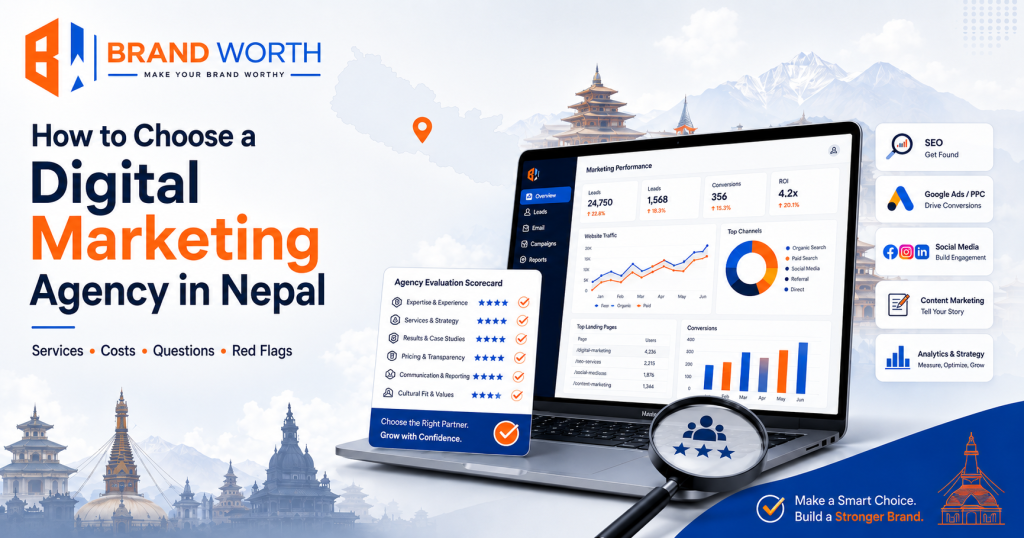
Digital Marketing Agency Comparison Scorecard
Use this Brand Worth 100-point framework to compare shortlisted agencies.
| Evaluation Area | Score |
|---|---|
| Understanding of your business | 15 |
| Strategic approach | 15 |
| Relevant capabilities | 15 |
| Measurement framework | 15 |
| Team quality | 10 |
| Relevant work/evidence | 10 |
| Ownership and transparency | 10 |
| Communication and process | 5 |
| Commercial value | 5 |
| Total | 100 |
Hard-Fail Checks
Regardless of the score, investigate carefully if an agency:
- Refuses appropriate client access to accounts
- Cannot explain measurement
- Hides media spending
- Guarantees impossible outcomes
- Cannot identify who will execute the work
- Has no handover process
The scorecard is a Brand Worth decision framework, not an industry certification.
Digital Marketing Agency vs Freelancer vs In-House Team
There is no universally best model.
| Option | Usually Best For | Main Advantage |
|---|---|---|
| Freelancer | Focused specialist assignments | Flexibility |
| Agency | Multi-skill campaigns | Coordinated specialists |
| In-house team | High continuous workload | Daily control and business knowledge |
| Hybrid | Growing companies | Internal ownership + external expertise |
A freelancer may be ideal for one specialist requirement.
An agency becomes more useful when the project requires several disciplines working together.
An internal team may be better when marketing volume is high enough to support permanent specialists.
Many organisations ultimately use a hybrid structure.
For a deeper comparison, read Digital Marketing Agency vs Freelancer in Nepal.
How Much Does a Digital Marketing Agency Cost in Nepal?
There is no meaningful universal price for digital marketing agency services because two proposals may represent completely different scopes.
A proposal should separate:
| Cost | What It Covers |
|---|---|
| Agency fee | Strategy, management, execution and reporting |
| Media spend | Google, Meta, TikTok and other paid placements |
| Production | Photography, video, animation and editing |
| Influencer costs | Creator fees and usage rights |
| Website work | Development, landing pages and optimization |
| Technology | Analytics, CRM and specialist software |
| Research | Surveys, interviews or fieldwork |
| Taxes/charges | Applicable taxes and transaction costs |
One agency may appear inexpensive because its proposal excludes:
- Strategy
- Video
- Advertising management
- Copywriting
- Website changes
- Tracking
- Reporting
Another may charge more because those activities are already included.
Therefore, compare:
Total cost required to execute the strategy properly
rather than:
Lowest monthly number on the proposal
Unsupported universal price ranges can be misleading because a small local campaign and a nationwide integrated launch require fundamentally different resources.
How to Compare Two Agency Proposals Properly
Normalize the proposals before comparing them.
Create rows for:
- Strategy
- Research
- SEO
- Google Ads
- Meta advertising
- Social media
- Copywriting
- Design
- Photography
- Video
- Website work
- Influencers
- Tracking
- Reporting
- Account management
- Media budget
- Taxes
- Third-party costs
Mark each line:
Included / Extra / Not Provided
Only then compare the total cost.
A proposal may appear cheaper simply because major components are missing.
What Should the First 30 Days With a Digital Marketing Agency Look Like?
The first month should create clarity, access, measurement and strategic direction.
Week 1 — Discovery and Access
- Business interviews
- Existing campaign review
- Website access
- Advertising-account access
- Analytics access
- Historical data review
- Competitor review
Week 2 — Audit and Measurement
- Website audit
- SEO baseline
- Advertising audit
- Social audit
- Analytics review
- Conversion-tracking plan
Week 3 — Strategy and Production
- Audience definition
- Channel strategy
- Campaign structure
- Content plan
- Creative development
- Landing-page requirements
Week 4 — Launch and Baseline
- Campaign launch
- Tracking verification
- Initial optimization
- Reporting baseline
- Next-stage priorities
The exact process will vary by assignment.
The important principle is:
Understand and instrument the business before aggressively scaling marketing spend.
When Should You Hire a Digital Marketing Agency?
Hiring an agency may make sense when:
- Marketing is inconsistent or reactive
- Advertising is running without conversion tracking
- The website receives traffic but few enquiries
- Several suppliers create inconsistent communication
- Your business needs SEO, advertising, content and creative together
- Management cannot identify what marketing is producing
- You are entering a new market
- A product is being launched
- Marketing has become too large for one employee
- You need specialist skills without building a large internal department
- The company needs structured reporting
When Should You Not Hire an Agency Yet?
Marketing cannot solve every underlying business problem.
Consider fixing the business first if:
- The product or service is unclear
- Customer service is severely weak
- Nobody answers incoming leads
- Inventory cannot meet demand
- Pricing is fundamentally uncompetitive
- The sales process is broken
- Distribution cannot support expansion
- The business has no realistic marketing resources
If the sales team takes several days to respond to every enquiry, generating more leads may simply increase waste.
Fix the bottleneck first.
Digital Marketing Agency Red Flags
Guaranteed #1 Google Rankings
No digital marketing or SEO agency controls Google’s organic rankings.
Be cautious of guaranteed position-one promises by a fixed date.
Guaranteed Revenue Before Research
Sales depend on many factors beyond advertising, including product, price, competition, sales follow-up and customer experience.
No Conversion Tracking
If nobody can determine what actions customers take after seeing a campaign, scaling the campaign becomes difficult to justify.
No Client Access to Accounts
Businesses should retain appropriate control of their core digital assets.
Vanity Metrics Only
Followers, impressions, reach and views can be useful, but they should not replace business metrics when the objective is leads or sales.
Unclear Media Spending
The proposal should distinguish:
Money paid to the agency
from:
Money paid to advertising platforms and media owners
Fake Followers or Engagement
Artificial numbers may make a profile appear larger without increasing business value.
No Exit or Handover Process
The contract should explain what happens to:
- Accounts
- Files
- Data
- Reports
- Advertising assets
- Website credentials
- Creative materials
when the relationship ends.
Who Should Own Your Digital Marketing Accounts?
The client should generally retain ownership or appropriate administrative control of important business assets.
Review ownership of:
- Domain
- Hosting
- Website CMS
- Google Business Profile
- Google Analytics
- Google Search Console
- Google Tag Manager
- Google Ads
- Meta Business Portfolio
- Facebook Page
- Instagram account
- Advertising accounts
- Pixels/datasets
- Product catalogues
- YouTube
- TikTok
- Email platform
- CRM
- Design files
- Video masters
- Historical reports
Also clarify contractual ownership of:
- Raw footage
- Editable files
- Photography
- Research
- Campaign templates
- Music licences
- Influencer usage rights
Ownership becomes particularly important during handover.
How Should a Top Digital Marketing Agency Report Results?
A useful agency report should answer four questions:
- What did we do?
- What happened?
- Why did it happen?
- What should we do next?
Different objectives require different KPIs.
| Objective | Useful Metrics |
|---|---|
| Awareness | Qualified reach, frequency, video completion, branded demand |
| Website traffic | Relevant visits, engagement, visitor-to-lead conversion |
| Lead generation | Qualified leads, CPL, conversion rate |
| Sales | Revenue, CAC, ROAS, conversion value |
| SEO | Non-branded clicks, commercial visibility, organic leads |
| Social media | Relevant engagement, audience quality, assisted conversions |
| Retention | Repeat purchases, retention and customer value |
A dashboard without interpretation is not a strategy.
Choosing a Digital Marketing Agency for Different Industries
Different organisations should prioritize different capabilities.
| Organisation | Important Capabilities |
|---|---|
| Startup | Prioritisation, website, tracking, focused acquisition |
| Corporate brand | Governance, integrated campaigns, production, reporting |
| Healthcare | Accuracy, trust, expert content, reputation |
| Education | Admissions strategy, search, Meta campaigns, lead qualification |
| Hospitality | Search visibility, visual content, booking conversion, reviews |
| Ecommerce | SEO, performance marketing, CRO, product feeds |
| NGO/INGO | Awareness, documentation, multilingual communication, reporting |
| B2B company | Search, thought leadership, lead generation, measurement |
| International company entering Nepal | Research, localisation, media and cultural understanding |
The correct agency should understand the commercial and operational realities of the organisation—not simply the advertising platform.
20 Questions to Ask Before Hiring a Digital Marketing Agency in Nepal
- What business objective would you prioritise for us?
- What research would you complete first?
- Which marketing channels would you recommend?
- Which channels would you avoid initially?
- Who will lead our account?
- Who will perform the specialist work?
- What will be outsourced?
- What deliverables are included?
- How are revisions handled?
- Who owns our digital accounts?
- Will our team have administrator access?
- How will conversions be tracked?
- How will lead quality be defined?
- Is advertising spending separate from the agency fee?
- Which costs are excluded?
- Which KPIs define success?
- How frequently will reports be provided?
- What happens when a campaign underperforms?
- What are the termination terms?
- What happens to our data, accounts and files after the contract ends?
A professional agency should welcome questions like these.
What Should Be Included in a Digital Marketing Agency Proposal?
A strong proposal should clearly explain:
- Business context
- Objective
- Target audience
- Priority geography
- Strategic rationale
- Recommended channels
- Scope of work
- Deliverables
- Production requirements
- Content requirements
- Website requirements
- Media plan
- Timeline
- Team structure
- Approval process
- KPIs
- Reporting
- Agency fee
- Media spending
- Third-party costs
- Exclusions
- Payment terms
- Contract period
- Termination
- Ownership
- Confidentiality
- Data handling
A proposal should make it possible for management to understand what will happen, who will do it, what it will cost and how performance will be evaluated.
Final Checklist for Choosing the Best Digital Marketing Agency in Nepal
Before signing a contract, confirm:
- The business objective is clear.
- The target audience is defined.
- The agency has explained why each channel is recommended.
- The strategy is specific to your business.
- Deliverables are documented.
- Exclusions are documented.
- The actual delivery team is known.
- Agency fees and media spend are separated.
- Production costs are clear.
- Conversion tracking is planned.
- Lead quality is defined.
- Relevant work or evidence has been reviewed.
- Reporting frequency is agreed.
- Your business retains appropriate account access.
- Creative ownership is clear.
- Approval procedures are defined.
- Contract termination terms are understood.
- A handover process exists.
- The agency does not make unsupported ranking, lead or revenue guarantees.
If several agencies remain after this evaluation, use the Brand Worth Agency Comparison Scorecard rather than selecting purely on price.
Why Consider Brand Worth as Your Digital Marketing Agency in Nepal?
Brand Worth may be worth considering when your business needs more than isolated social media execution.
The agency combines digital marketing with research, advertising, production, media, website development and events under one coordinated structure.
That can be valuable when a campaign requires several connected activities such as:
Research → Strategy → Creative → Production → Digital Distribution → Media → Measurement
or:
SEO → Website Improvement → Content → Lead Generation → Conversion Tracking
or:
Product Launch → Advertising → Video → Influencers → Digital Media → Event Activation
The objective is not to use every service in every campaign.
It is to have the capabilities available when the strategy genuinely requires them.
Explore Brand Worth’s Digital Marketing services or review our approach to understand how campaigns are planned and executed.
Frequently Asked Questions
Which Is the Best Digital Marketing Agency in Nepal?
There is no single agency that is objectively best for every business. The best digital marketing agency in Nepal for your organisation should understand your business objective, have the required specialist capabilities, provide relevant evidence, protect account ownership, measure meaningful KPIs and communicate its costs clearly.
What Makes a Digital Marketing Agency One of the Top Agencies in Nepal?
A top digital marketing agency should combine strategy, specialist execution, creative quality, measurement, transparent account ownership and evidence of relevant work. Businesses requiring complex campaigns should also evaluate whether the agency can coordinate SEO, paid media, content, production, website work, advertising and other channels effectively.
Is Brand Worth a Digital Marketing Agency in Nepal?
Yes. Brand Worth is an integrated media and marketing agency headquartered in Kathmandu, with a dedicated Digital Marketing vertical alongside Advertising, Events & Experiences, Market Research, Production, Media & Campaigns and Website Development.
Explore Brand Worth’s Digital Marketing Services →
Why Choose Brand Worth for Digital Marketing?
Brand Worth may be particularly suitable for businesses that need digital marketing to connect with research, creative production, advertising, website development, media or events. Businesses should evaluate Brand Worth using the same strategy, capability, proof, ownership, measurement, commercial and working-fit criteria recommended throughout this guide.
What Services Does a Digital Marketing Agency in Nepal Provide?
Services can include SEO, Google Ads, Meta advertising, social media marketing, content creation, performance marketing, influencer marketing, video production, website optimization, landing pages, analytics and conversion tracking. Integrated agencies may also provide research, traditional advertising, media, production and events.
How Do I Choose Between Digital Marketing Agencies in Nepal?
Start by defining your business objective. Then compare agencies according to strategy, relevant capabilities, delivery team, evidence, account ownership, measurement, pricing transparency and communication. Do not select an agency only because it has the cheapest package or largest follower count.
How Much Does Digital Marketing Cost in Nepal?
There is no universal cost because requirements differ significantly. Businesses should separate agency fees from advertising spend, production, influencer fees, website development, technology, research and applicable taxes before comparing proposals.
Should I Hire a Digital Marketing Agency or Freelancer?
A freelancer can be effective for a focused specialist assignment. An agency is often more appropriate when several marketing capabilities must operate together. Larger companies may also use a hybrid structure with an internal marketing team supported by specialist agencies.
How Long Does Digital Marketing Take to Work?
The timeline depends on the channel and objective. Paid advertising can begin producing performance data relatively quickly after proper setup, while SEO and brand-building generally require longer-term development. The more useful question is what should be measured and improved at each stage.
Can a Digital Marketing Agency Guarantee Sales?
A responsible agency should not guarantee sales before understanding the business. Marketing performance can be influenced by the product, price, market demand, competition, website, sales process, customer experience and many other factors.
Can a Digital Marketing Agency Guarantee the Number-One Google Position?
No agency controls Google’s organic search results. SEO can improve technical quality, relevance, content, authority and user experience, but a guaranteed organic ranking by a specific date should be treated cautiously.
Where Is Brand Worth Located?
Brand Worth is headquartered in Kathmandu, Nepal, and works with businesses requiring digital marketing and integrated marketing support in the Nepali market.
Looking for a Digital Marketing Agency in Nepal?
If you are comparing the best digital marketing agencies in Nepal, do not begin by asking which company publishes the most content or offers the cheapest package.
Begin with your business objective.
Then evaluate:
Strategy → Capability → Proof → Ownership → Measurement → Commercials → Working Fit
Brand Worth works with businesses that need digital marketing connected to measurable business objectives and, where necessary, supported by research, advertising, production, website development, media and events.
If that matches what your organisation needs, contact Brand Worth to discuss your business, current marketing challenges and the outcomes you want to achieve.
Turn the insight into action.
Tell us what you are trying to grow, launch or improve. We will connect you with the right specialist team.
Discuss your project →