
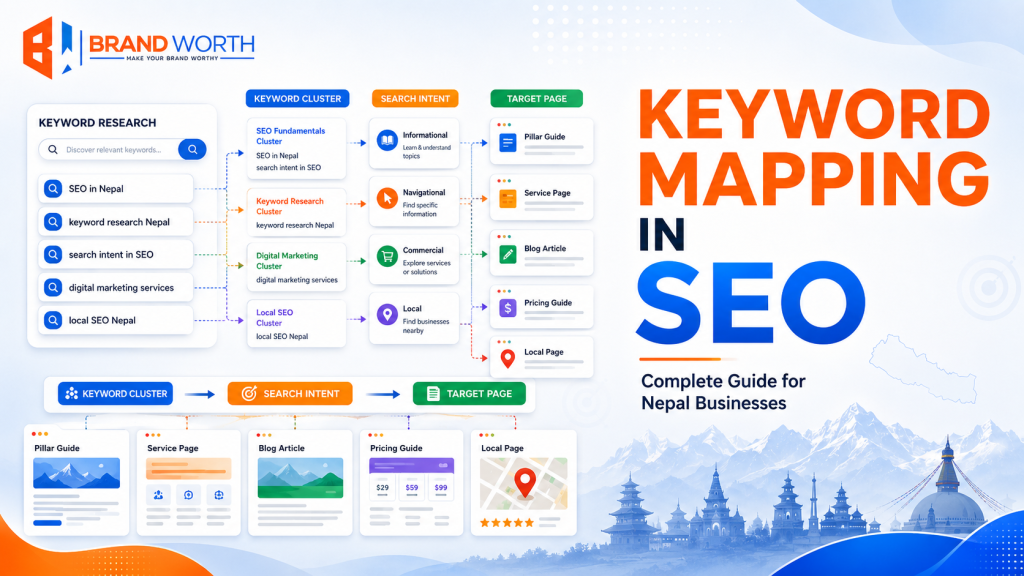
Keyword mapping is the process of assigning each important keyword cluster and search intent to the most appropriate page on a website.
It answers three practical questions:
- Which keywords should the website target?
- Which existing or planned page should target each keyword?
- What action should be taken when several pages compete for the same search intent?
Without keyword mapping, businesses often create content based on isolated keyword ideas. The result can be duplicate articles, weak service pages, confusing internal links and several URLs competing for the same searches.
A properly constructed keyword map turns keyword research in Nepal into an actionable plan for website architecture, content production, internal linking and organic growth.
What Is Keyword Mapping in SEO?
Keyword mapping is the practice of grouping related search terms and assigning each group to one existing or planned website page.
A keyword map typically records:
- The keyword cluster
- Primary search intent
- Recommended page type
- Target URL
- Existing ranking page
- Supporting keywords
- Content status
- Internal links
- Conversion objective
- Recommended SEO action
For example, these phrases should not automatically become three separate articles:
- Keyword mapping in SEO
- SEO keyword mapping
- How to map keywords to website pages
They express substantially the same informational need. They can therefore be assigned to one comprehensive guide.
However, the following searches require different pages:
| Keyword | Main intent | Appropriate page |
|---|---|---|
| What is SEO? | Informational | Educational guide |
| SEO in Nepal | Informational | Nepal-focused SEO pillar |
| SEO services in Nepal | Transactional | SEO service page |
| SEO cost in Nepal | Commercial investigation | Pricing guide |
| SEO agency near me | Local-commercial | Local service page |
The topic may be similar, but the searcher’s purpose is different.
This is why keyword mapping must be built on both keyword research and search-intent analysis.
Why Is Keyword Mapping Important?
Keyword mapping helps every important page serve a distinct purpose while supporting the wider website structure.
A website without a keyword map may publish content whenever a new idea appears. Over time, the site can accumulate several articles and service pages with overlapping titles, headings and target queries.
This creates practical problems:
- The wrong page may appear for an important search.
- Several pages may divide links and relevance.
- Content teams may repeatedly cover the same subject.
- Important commercial searches may have no suitable landing page.
- Internal links may point to different URLs using similar anchor text.
- Website navigation may reflect company departments rather than customer needs.
- Informational traffic may never reach relevant commercial pages.
A keyword map prevents these problems by establishing one primary page for each important intent.
Brand Worth’s broader guide to SEO in Nepal already places keyword research, website architecture, content and internal linking within the same organic-search system. A keyword map is the document that connects those areas during implementation. (Brand Worth)
Keyword Research, Clustering and Mapping: What Is the Difference?
Keyword research finds opportunities, clustering organizes them, and keyword mapping assigns them to pages.
| Process | Main question | Output |
|---|---|---|
| Keyword research | What are customers searching for? | Keyword dataset |
| Search-intent analysis | What does the searcher expect? | Intent classification |
| Keyword clustering | Which terms require the same answer? | Topic and intent groups |
| Keyword mapping | Which page should own each cluster? | Keyword-to-URL plan |
| Content planning | What must the page contain? | Content brief |
| Internal linking | How should related pages connect? | Link architecture |
| Measurement | Is the page gaining relevant visibility? | Performance report |
These stages are related, but they should not be treated as identical.
A spreadsheet containing thousands of keywords is not yet a keyword map. It becomes a map only after the terms have been grouped, prioritized and assigned to URLs.
What Should a Keyword Map Include?
A useful keyword map should contain enough information for SEO, content and development teams to act without repeating the research.
A practical spreadsheet can include the following columns:
| Column | Purpose |
|---|---|
| Keyword cluster | Groups terms that require the same page |
| Primary keyword | Represents the cluster |
| Supporting keywords | Records close variations and related questions |
| Search intent | Defines what the user wants |
| Customer-journey stage | Shows awareness, consideration or decision stage |
| Recommended page type | Guide, service, product, category or location page |
| Target URL | Identifies the preferred destination |
| URL status | Existing, planned, update, merge or redirect |
| Current ranking URL | Shows which page Google currently displays |
| Business relevance | Measures connection to the offering |
| Priority | Determines implementation order |
| Internal links from | Identifies supporting pages |
| Internal links to | Identifies pillar and commercial destinations |
| CTA | Defines the appropriate next action |
| Owner | Assigns responsibility |
| Review date | Establishes when the mapping will be revisited |
Not every project requires every column. A small service business may use a simple map, while an ecommerce website may need product categories, filters, regional pages and thousands of keyword clusters.
The Brand Worth Keyword-to-Page Framework
A strong keyword map connects business value, search intent, page type and conversion purpose in one sequence.
The Brand Worth Keyword-to-Page Framework follows seven stages:
Business Goal → Keyword Cluster → Search Intent → Page Type → Target URL → Internal Links → Conversion Goal
1. Business Goal
Define what the website needs to generate:
- Qualified enquiries
- Sales
- Appointments
- Applications
- Registrations
- Dealer interest
- Store visits
- Brand authority
2. Keyword Cluster
Group phrases that represent the same topic and user need.
3. Search Intent
Determine whether the search is informational, commercial, transactional, navigational or local.
4. Page Type
Choose the format most likely to satisfy that intent.
5. Target URL
Assign the cluster to one preferred URL.
6. Internal Links
Connect the page with relevant pillar, supporting and commercial pages.
7. Conversion Goal
Define the appropriate next action for the visitor.
This prevents a common SEO mistake: selecting a keyword without deciding what purpose the resulting page will serve.
How to Create a Keyword Map Step by Step
Step 1: Define the Website’s Business Priorities
Begin by identifying the services, products, audiences and outcomes that matter most to the business.
Do not begin with a keyword tool.
Start with questions such as:
- Which services generate the most value?
- Which products have the strongest margins?
- Which customer groups are priorities?
- Which locations can the business genuinely serve?
- Which services need more enquiries?
- Which areas require authority-building before selling?
- Which pages already generate leads?
- Which offerings have no dedicated pages?
For example, a Kathmandu marketing agency may prioritize:
- Digital marketing services
- SEO
- Google Ads
- Social media marketing
- Market research
- Website strategy
- Brand campaigns
These commercial priorities should shape the research.
Brand Worth’s research-led approach begins with audience studies, competitor mapping and market information before campaign execution, which is also an effective principle for keyword mapping. (Brand Worth)
Step 2: Audit Existing Website Pages
Create an inventory of every indexable page before assigning new keywords.
The inventory should include:
- URL
- Page title
- H1
- Page type
- Main subject
- Existing organic traffic
- Search queries
- Internal links
- Indexing status
- Last update
- Conversion purpose
Pages commonly overlooked during an audit include:
- Old blog posts
- Campaign landing pages
- Tag archives
- Category archives
- Location pages
- Previous service pages
- Test pages
- PDF resources
- Duplicate URLs
- Parameter-based pages
The purpose is to understand what already exists before proposing new pages.
Creating content without this audit can lead to duplicate targeting and unnecessary production.
Step 3: Collect the Keyword Research
Build the keyword dataset using customer language, first-party data and relevant research tools.
Useful sources include:
- Google Search Console
- Google Keyword Planner
- Google Trends
- Google autocomplete
- Related searches
- People Also Ask
- Customer enquiries
- Sales-call notes
- Website search data
- CRM records
- Competitor pages
- Industry terminology
- Paid SEO platforms
For Nepal-focused projects, test:
- English searches
- Devanagari Nepali searches
- Romanized Nepali searches
- Location modifiers
- Industry-specific vocabulary
- Informal customer wording
For a complete process, use the guide to keyword research in Nepal.
Step 4: Clean and Standardize the Dataset
Remove irrelevant, duplicated and misleading keyword entries before clustering them.
Common cleaning tasks include:
- Removing exact duplicates
- Correcting obvious formatting errors
- Separating branded and non-branded terms
- Removing irrelevant locations
- Removing products the business does not offer
- Labeling language variations
- Standardizing capitalization
- Separating singular and plural terms only when intent differs
- Identifying seasonal terms
- Marking sensitive or regulated topics
Do not delete every low-volume query.
A specific term may still be valuable when it closely matches a profitable service or repeatedly appears in customer enquiries.
Step 5: Classify Search Intent
Assign each keyword to the purpose the searcher is trying to achieve.
The main categories are:
| Search intent | User objective | Common page type |
|---|---|---|
| Informational | Learn or solve a problem | Guide, tutorial or explainer |
| Commercial investigation | Compare options | Comparison or pricing guide |
| Transactional | Buy, book or enquire | Product or service page |
| Navigational | Reach a specific destination | Homepage or branded page |
| Local | Find a nearby solution | Local service or location page |
Do not rely entirely on modifiers such as “best,” “price” or “how.”
Search the keyword and examine:
- Ranking page types
- Result formats
- Local results
- Videos
- Images
- Featured snippets
- Shopping results
- AI-generated results
- Major ranking entities
The current search results provide stronger evidence of expected page type than the wording alone.
The detailed search-intent guide explains this process further.
Step 6: Group Keywords into Clusters
Place keywords together when one page can satisfy their shared intent comprehensively.
For example, one cluster could contain:
- Keyword mapping in SEO
- SEO keyword mapping
- Keyword-to-page mapping
- How to assign keywords to pages
- Website keyword map
- Keyword mapping process
These terms can be covered by one guide because the expected answer is substantially the same.
Another cluster may contain:
- Keyword mapping template
- Free keyword mapping template
- Keyword map spreadsheet
- SEO mapping template Excel
This could either become a section of the main guide or a separate downloadable template page, depending on the search results and business value.
Cluster by Intent, Not Only by Shared Words
These queries contain similar language but should not necessarily share one page:
- What is keyword research?
- Keyword research services Nepal
- Best keyword research tools
- Keyword research course
- Keyword research template
Their wording overlaps, but their expected results differ.
Step 7: Choose the Correct Page Type
Match each cluster with the page format the user expects.
| Keyword pattern | Recommended page |
|---|---|
| What is, how to, guide | Educational article |
| Best, versus, alternatives | Comparison guide |
| Cost, price, packages | Pricing guide |
| Services, company, agency | Service page |
| Buy, order, shop | Product or category page |
| Near me, city modifier | Local service or location page |
| Login, official website | Branded or navigational page |
| Calculator, generator, checker | Interactive tool |
This stage is especially important because one page type cannot satisfy every search.
A blog article may support a service page, but it should not automatically replace it.
Step 8: Assign One Primary URL to Each Cluster
Every priority keyword cluster should have one preferred destination.
The URL may be:
- An existing page
- A page requiring expansion
- A planned new page
- A page created by merging several weak URLs
- A replacement for an obsolete page
Example:
| Keyword cluster | Target URL |
|---|---|
| SEO in Nepal | /seo-in-nepal/ |
| Keyword research in Nepal | /keyword-research-in-nepal/ |
| Search intent in SEO | /search-intent-in-seo/ |
| Keyword mapping in SEO | /keyword-mapping-in-seo/ |
| Local SEO in Nepal | /local-seo-in-nepal/ |
| Digital marketing in Nepal | /digital-marketing-in-nepal-complete-guide-for-businesses-in-2026/ |
| Digital marketing services | /verticals/digital-marketing/ |
The rule is not “one keyword per page.”
The better rule is:
One dominant intent and one coherent keyword cluster per primary page.
Step 9: Evaluate Existing Pages Before Creating New Ones
A new keyword opportunity does not automatically require a new URL.
For each cluster, select one of the following actions.
Keep
Use when the existing page:
- Matches the intent
- Covers the topic sufficiently
- Has a clear purpose
- Performs reasonably well
- Does not overlap significantly
Update
Use when the page targets the correct intent but contains outdated details, weak examples or incomplete information.
Expand
Use when the page is useful but lacks important subtopics, FAQs, comparisons or decision guidance.
Retarget
Use when the content can serve a more suitable keyword than the one originally assigned.
Merge
Use when several weak pages answer substantially the same question.
Redirect
Use when an obsolete or duplicate URL no longer deserves to remain independently accessible.
Google recommends using redirects when a URL has moved and canonical signals when several duplicate or very similar URLs need to be consolidated. These are implementation tools, not substitutes for improving the content strategy. See Google’s guidance on redirects and canonicalization.
Step 10: Map Supporting and Commercial Relationships
A keyword map should show how educational pages support commercial pages without turning every article into a sales pitch.
For example:
- A guide to keyword research can link to keyword mapping.
- A keyword-mapping article can link to search intent.
- All three can support the broader SEO in Nepal pillar.
- Educational SEO pages can link naturally to digital marketing services.
- Audience-research sections can link to market research.
- Visitors ready to discuss implementation can reach the Brand Worth contact page.
Brand Worth’s digital marketing vertical includes SEO, Google Ads, social media and performance marketing, while its market-research vertical covers consumer studies, business intelligence and brand tracking. These connections make it possible to support search strategy with both audience evidence and implementation. (Brand Worth)
Step 11: Plan Internal Links
Internal links should show users and search engines how pages relate to one another.
Each priority page should have:
- Links from relevant supporting content
- Links to its parent pillar
- Links to useful related pages
- Links to an appropriate commercial destination
- Descriptive anchor text
Google states that links help it discover pages, while clear anchor text helps users and Google understand what the linked page contains. It also recommends ensuring that every page considered important is linked from at least one other page. See Google’s link best practices.
Weak Anchor Text
- Click here
- Learn more
- Read this
- More information
Stronger Contextual Anchor Text
- keyword research in Nepal
- understand search intent
- SEO strategy for Nepal businesses
- professional digital marketing services
- consumer and market research
The anchor should sound natural within the sentence. It should not be repeated mechanically across hundreds of pages.
Step 12: Assign Conversion Goals
Every mapped page should have an appropriate business or user outcome.
| Page intent | Suitable next action |
|---|---|
| Informational | Read a supporting guide |
| Commercial | Compare options or review a service |
| Transactional | Request a quotation |
| Local | Call, visit or get directions |
| Navigational | Continue to the intended destination |
| Research resource | Download a template |
| Thought-leadership article | Subscribe or explore related insight |
An informational page should educate before selling.
A searcher reading about keyword mapping may not be ready to hire an agency immediately. The article should first help them complete the process and then offer professional support as an optional next step.
Step 13: Prioritize the Implementation
Do not treat every mapped keyword as equally urgent.
Prioritize clusters using:
- Business relevance
- Search intent
- Existing performance
- Conversion potential
- Ranking feasibility
- Content gap
- Technical dependency
- Seasonal timing
- Available expertise
- Strategic importance
A page with moderate search demand but strong commercial relevance may deserve attention before a broad, high-volume article.
Suggested Priority Levels
Priority 1: Commercial pages, severe cannibalization and near-ranking opportunities
Priority 2: High-value supporting guides and missing content clusters
Priority 3: Long-term authority content and lower-confidence opportunities
Priority 4: Experimental, seasonal or emerging searches
Step 14: Build the Content Brief
Translate each priority cluster into clear publishing requirements.
The brief should contain:
- Primary intent
- Target audience
- Primary keyword
- Supporting terms
- Recommended H1
- Required sections
- Questions to answer
- Entities to explain
- Internal links
- External references
- Visual requirements
- CTA
- Author expertise
- Schema
- Measurement plan
Google’s guidance recommends creating helpful, reliable and people-first content that provides original value and leaves visitors feeling that they have learned enough to achieve their goal. See Google’s people-first content guidance.
Step 15: Measure the Result
Use Search Console and conversion data to verify whether Google is showing the intended page for the mapped queries.
The Search Console Performance report can be used to:
- Review queries generating impressions
- Identify the pages shown for a specific query
- Find high-impression, low-CTR opportunities
- Compare page performance
- Separate branded and non-branded demand
- Observe changes over time
Google notes that the Pages dimension generally aggregates performance around the canonical URL. It also allows website owners to select a query and then inspect which pages were shown for that query. (Google Support)
A keyword map should therefore be updated using actual performance data rather than treated as a permanent document.
Keyword Mapping Example for a Digital Marketing Agency in Nepal
A digital marketing agency needs separate informational, commercial and service pages even when the subjects are closely related.
| Keyword cluster | Intent | Page type | Recommended destination |
|---|---|---|---|
| Digital marketing in Nepal | Informational | Complete guide | Digital marketing in Nepal |
| Digital marketing services | Transactional | Service page | Digital marketing services |
| SEO in Nepal | Informational | Pillar guide | SEO in Nepal |
| Keyword research in Nepal | Informational | Specialist guide | Keyword research in Nepal |
| Search intent in SEO | Informational | Specialist guide | Search intent in SEO |
| Keyword mapping in SEO | Informational | Specialist guide | Current article |
| Market research Nepal | Commercial or transactional | Service page | Market research |
| Digital marketing agency Nepal | Commercial investigation | Agency-selection or commercial page | Dedicated commercial page |
| Contact Brand Worth | Navigational | Contact page | Contact Brand Worth |
This structure prevents one general article from trying to rank for every SEO and digital-marketing search.
It also creates a logical journey:
Keyword research discovers demand → Search-intent analysis interprets the demand → Keyword mapping assigns it to pages → Content and website teams implement the plan.
Keyword Mapping for Service Businesses
Service businesses should separate educational searches from provider-selection searches.
Consider a modular-kitchen company.
| Keyword | Intent | Page |
|---|---|---|
| What is a modular kitchen? | Informational | Beginner’s guide |
| Modular kitchen price in Nepal | Commercial | Pricing guide |
| Best modular kitchen company Nepal | Commercial | Company-selection guide |
| Modular kitchen Kathmandu | Transactional/local | Service page |
| MDF vs plywood kitchen | Informational/commercial | Comparison guide |
| Contact kitchen company | Transactional | Contact page |
A single page cannot serve all these purposes equally well.
Keyword Mapping for Ecommerce Websites
Ecommerce keyword mapping should prioritize category, subcategory and product intent before publishing large numbers of blog posts.
Typical structure:
| Search type | Page type |
|---|---|
| Broad product category | Category page |
| Product subtype | Subcategory page |
| Specific model | Product page |
| Brand plus product | Brand collection page |
| Product comparison | Comparison article |
| Buying advice | Buying guide |
| Delivery location | Relevant shipping or location page |
Common ecommerce mapping errors include:
- Targeting category terms with individual products
- Creating blog posts for searches that expect shopping pages
- Allowing filters to generate duplicate indexable URLs
- Publishing near-identical manufacturer descriptions
- Competing category and subcategory pages
- Removing products without a redirect or replacement plan
Keyword Mapping for Local SEO
Local keyword mapping should be based on genuine service coverage and distinct local value.
A business may research searches such as:
- SEO agency Kathmandu
- SEO company Lalitpur
- Digital marketing agency Tinkune
- Advertising agency near me
- Event management company Pokhara
Do not automatically create one page for every city.
Create a separate location page only when the business can provide useful, specific information such as:
- Services available in that location
- Local projects
- Delivery or operating coverage
- Local customer questions
- Directions or landmarks
- Staff or office details
- Testimonials
- Relevant photographs
For a wider explanation of Google Maps and geographic visibility, see the guide to local SEO in Nepal.
English, Nepali and Romanized Nepali Keyword Mapping
Language variations should be mapped according to audience need, intent and content quality—not automatically separated into multiple pages.
A Nepal-focused business may encounter:
| Format | Example |
|---|---|
| English | Digital marketing agency Nepal |
| Devanagari Nepali | नेपालमा डिजिटल मार्केटिङ एजेन्सी |
| Romanized Nepali | Nepal ma digital marketing agency |
| Mixed language | Kathmandu ma best SEO company |
The mapping decision depends on:
- Whether the intended audience differs
- Whether the page will be fully translated
- Whether search results differ materially
- Whether the same page can serve both terms naturally
- Whether separate language versions can be maintained
- Whether hreflang implementation is required
Do not create low-quality translated pages merely to occupy more keywords.
A separate Nepali-language page is justified when it delivers a complete and genuinely useful Nepali experience—not when it repeats an English page with a few translated phrases.
How Keyword Mapping Prevents Cannibalization
Keyword mapping reduces cannibalization by identifying one preferred URL for each dominant intent.
Possible signs of overlap include:
- Similar titles across several pages
- Similar H1 headings
- Repeated sections and examples
- Multiple URLs appearing for the same query
- Ranking positions switching between URLs
- Internal links pointing inconsistently
- A blog ranking instead of a service page
- A category page competing with a product page
However, two pages ranking for related keywords do not automatically indicate a problem.
The question is whether the pages serve different purposes.
For example:
- “SEO in Nepal” can be an informational guide.
- “SEO services in Nepal” can be a commercial service page.
The subject overlaps, but the search intent and visitor journey differ.
Create, Update, Merge, Redirect or Retarget?
Use the following decision framework when reviewing every mapped cluster.
| Situation | Recommended action |
|---|---|
| No relevant page exists | Create |
| Correct page exists but is outdated | Update |
| Page matches intent but lacks depth | Expand |
| Several weak pages share the same intent | Merge |
| Duplicate page is obsolete | Redirect |
| Existing content suits another keyword better | Retarget |
| Pages serve distinct intents | Keep separate |
| Keyword has no strategic value | Do not target |
Simple Decision Tree
Does a suitable page already exist?
- No: Consider creating a new page.
- Yes: Does it match the intent?
- Yes: Improve or retain it.
- No: Retarget it or create the correct page.
Are several pages answering the same need?
- Yes: Consider merging and redirecting.
- No: Keep their roles distinct.
Would the new page provide unique value?
- No: Do not create it.
- Yes: Add it to the content roadmap.
Keyword Mapping and AI Search
Keyword mapping for AI search should organize complete information needs, not produce a separate page for every conversational query.
A person may ask an AI search system:
How should a business in Nepal organize keywords across service pages and blog content without creating cannibalization?
This request contains several connected needs:
- Keyword research
- Search intent
- Page selection
- Service-page structure
- Blog architecture
- Cannibalization
- Internal linking
A well-mapped website can address these needs through a connected content cluster rather than one oversized page or dozens of near-duplicate articles.
Google’s guidance for generative Search states that established SEO foundations remain relevant. It also advises publishers to create valuable, distinctive content rather than relying on special AI-search tricks. See Google’s AI search optimization guidance.
Keyword mapping can support AI-search visibility by creating:
- Clear page purposes
- Logical entity relationships
- Comprehensive topic clusters
- Descriptive internal links
- Consistent terminology
- Stronger evidence paths
- Fewer duplicate pages
- More useful supporting context
Common Keyword-Mapping Mistakes
Mapping One Exact Keyword to Every Page
A page should target a coherent cluster, not only one exact phrase.
Creating One Page for Every Variation
Pages for “keyword mapping,” “SEO keyword mapping” and “keyword-to-page mapping” would probably overlap.
Ignoring Search Intent
Shared words do not guarantee shared intent.
Mapping Only Blog Content
Service, product, category, location and contact pages also need clear keyword roles.
Choosing Search Volume Over Business Relevance
A high-volume term may attract visitors who will never need the business.
Ignoring Existing Rankings
A page already ranking on the second page may deserve improvement before a new URL is created.
Treating the Map as Permanent
Search behaviour, services, competitors and website structure change.
Forgetting Internal Links
Mapped pages need contextual pathways between supporting, pillar and commercial content.
Mapping Keywords Without a CTA
Every page should have a logical next step, even when that step is simply reading another guide.
Creating Thin Location Pages
Replacing one city name with another does not create distinctive local value.
Allowing Several Teams to Create URLs Independently
Marketing, content, development and sales teams should work from the same map.
Measuring Only Rankings
Evaluate clicks, qualified traffic, engagement, leads and revenue where possible.
How Often Should a Keyword Map Be Updated?
Review the map whenever the website, market or search performance changes materially.
Monthly
- Review priority queries
- Check new Search Console data
- Identify unexpected ranking pages
- Add relevant customer questions
- Monitor important conversions
Quarterly
- Review priority clusters
- Check cannibalization
- Update page statuses
- Reassess internal links
- Examine declining pages
- Add new business priorities
Every Six to Twelve Months
- Conduct a full content inventory
- Revisit keyword research
- Review competitors
- Check URL hierarchy
- Consolidate weak pages
- Validate commercial priorities
- Update the publishing roadmap
Immediate Review Triggers
- A new service is launched
- The website is redesigned
- Several pages begin competing
- An important page loses visibility
- A location opens or closes
- Product categories change
- Search intent shifts
- A migration is planned
- A major algorithm or SERP change affects performance
Frequently Asked Questions
What is keyword mapping in SEO?
Keyword mapping is the process of grouping related keywords and assigning each group to the website page that best satisfies its search intent.
Why is keyword mapping important?
It helps organize website content, prevent overlap, identify missing pages and connect keyword research with site architecture.
How do I create a keyword map?
Audit existing pages, collect keywords, classify intent, group related terms, select page types and assign each cluster to one preferred URL.
What is the difference between keyword clustering and keyword mapping?
Clustering groups related terms together. Mapping assigns each resulting cluster to an existing or planned webpage.
Should every keyword have its own page?
No. Closely related terms that require the same answer should generally be covered by one strong page.
How many keywords can one page target?
There is no fixed number. One page can address many closely related phrases as long as they share a coherent topic and intent.
Can two pages target similar keywords?
Yes, when they serve different search intentions. An educational SEO guide and an SEO service page can cover related terminology without being duplicates.
What is keyword cannibalization?
Keyword cannibalization occurs when several pages compete for substantially the same search intent, making it unclear which URL should rank.
How can Search Console help with keyword mapping?
Search Console shows queries, impressions, clicks and the pages shown for particular searches. This can reveal existing opportunities and overlapping URLs.
Should I map keywords before redesigning a website?
Yes. Keyword mapping can inform navigation, page hierarchy, URL planning, content migration and internal linking before development begins.
Can keyword mapping help local SEO?
Yes. It can distinguish national, city-level and near-me intent and prevent the creation of unnecessary duplicate location pages.
Should English and Nepali keywords use separate pages?
Only when the audience, language experience or search results justify separate versions. Do not create weak translated pages solely to target more phrases.
How often should a keyword map be reviewed?
Priority areas should be reviewed quarterly, while a full review is generally useful every six to twelve months or after major website changes.
Is keyword mapping useful for AI search?
Yes. It helps build clear topic relationships and comprehensive content clusters that can answer broad and related questions without unnecessary duplication.
What tool is best for keyword mapping?
A spreadsheet is often sufficient. The quality of the research, intent analysis and page decisions matters more than the software used to record the map.
Keyword-Mapping Checklist
Before finalizing a keyword map, confirm:
- The business priorities are clear.
- Existing pages have been audited.
- Keywords have been cleaned and grouped.
- Search intent has been verified.
- Each cluster has an appropriate page type.
- Each priority cluster has one preferred URL.
- Existing pages have keep, update, merge or redirect decisions.
- Informational and commercial pages have distinct roles.
- Internal links have been planned.
- Every page has an appropriate next action.
- English, Nepali and Romanized searches have been considered where relevant.
- Local pages provide genuine local value.
- Search Console data will be used for future reviews.
- The map has an owner and update schedule.
Conclusion
Keyword mapping transforms SEO research into a practical website plan.
It determines:
- Which searches matter
- Which terms belong together
- What users expect
- Which page should answer each need
- Which existing pages should be improved
- Which new pages are justified
- How content should connect
- What action each page should support
The most useful principle is:
One dominant search intent, one coherent keyword cluster and one preferred page.
Following this principle helps businesses create fewer duplicate pages, improve internal linking, reduce cannibalization and build a website that is easier for customers and search engines to understand.
Keyword mapping should not be treated as a one-time spreadsheet exercise. It should remain connected to customer research, website development, content production and performance measurement.
Brand Worth combines market research, SEO and digital marketing and an evidence-led planning process to connect customer demand with practical implementation. Businesses requiring a structured keyword map, content roadmap or SEO audit can contact Brand Worth.
Turn the insight into action.
Tell us what you are trying to grow, launch or improve. We will connect you with the right specialist team.
Discuss your project →